Friday, December 01, 2006
Trade policies


Thursday, November 30, 2006
French Fries Under Fire
I recently read an article entitled, “Junk Food Jihad: Should We Regulate French Fries Like Cigarettes?” The article can be found at http://www.slate.com/id/2139941/nav/tap1/. In the article, author William Saletan contends that since the war on tobacco is all but won, government health officials need a new “whipping-cream boy.” Even though health officials predict that obesity will soon surpass tobacco use as the number one cause of preventable death, Saletan remains skeptical about the virtue of such a war. He points out that the rationale behind smoking bans was largely based on the injustice of secondhand smoke. However, there is no such thing as secondhand obesity.
In fact most people believe that obesity only affects the individual. But the rising incidence of obesity in the United States will have a huge impact on our economy. Obesity is a precursor to a whole host of debilitating and expensive diseases including diabetes, heart disease and cancer. In his article, Mr. Saletan reports that obesity has caused more than one-fourth of the rise in health care costs since 1987. Obesity also costs millions in lost productivity every year. But the question remains, is telling us what to eat a justifiable use of government’s coercive power?
The fact is that the government has been telling us what to eat since the Pure Food and Drug Act passed in 1906. Therefore it seems telling us whether or not we can eat trans fats and high fructose corn syrup would just be an extension of the law that is already in place. Although we don’t yet know the full effects of these chemicals on the human body, initial tests are far from encouraging. In fact, high fructose corn syrup interferes with chemical signals in the brain that tell the body it is full. Thus, a person may continue eating to excess because their brain cannot tell them that they are full. Manufactures choose to use these chemicals because they are cheaper than healthier alternatives
So what would Olson say? When I first saw this article I immediately thought about bootleggers and Baptists. The bootleggers in this case are the government health officials that need a cause to justify their positions and increase their funding. The Baptists are the American people who will have to bear the costs of higher medical expenses and lost productivity. By convincing us that obesity is a problem that affects all of us the bootleggers are trying to get public support for what might be yet another unpopular war. After all, people have to eat. And people love to eat their McDonalds and Twinkies – especially kids. And it just so happens that the kids are just what this war is all about.
Mr. Saletan reports that the food industry is being blamed for targeting children. The goal is to hook them while they are young so they will be faithful customers for life. But there is another bad guy in this story: the federal government. Some argue that by “subsidizing pork, sugar, cream, high fructose corn syrup” the government created the problem. But this is not the whole story. The subsidies levied in support of these industries are the result of predation by the industries themselves.
At some point pork and dairy farmers chose to redirect some of their productive capacity towards rent-seeking in an effort to increase their slice of the social pie. In so doing they made the pie smaller for everyone else. A more apt metaphor might be that they replaced mom’s homemade apple pie with an artificially flavored, freeze dried, microwaveable hot pocket. Now after years of growing fat off government subsidies these industries may be in for a fight.
Who will be this war’s “Biggest Loser” is anyone’s guess. But the fact that the government has called Ronald McDonald in for questioning would not surprise Olson. Where ever there are opportunistically minded bootleggers and Baptists willing to jump on the band wagon, there exists the possibility of government’s coercive power being used for seemingly unlikely purposes.
Saturday, November 25, 2006
Capacity for Violence?
So, in an effort to keep the war effort back home strong and public opinion favorable, Bush turned to Operation Iraqi Freedom whose plan was to disarm Iraq of weapons of mass destruction, to end Saddam Hussein's support of terrorism, and to free the Iraqi people. Almost three years later it would seem on the surface that the US has reached those goals, except for the one forgotten detail that now seems to television and newspaper reports alike: How are we going to exit Iraq without it all falling to pieces?
Olson brings uo a good point in The Rise and Decline of Nations about how the country with the largest capacity for violence is often the one who comes out on top. Now we all know that the US has quite a large capacity for violence. We've witnessed it on several occasions and the coercive effect that it can have on nations. After all it did end WWII. So why does the US remain in this limbo regarding the situation in Iraq? Why do we continually let these radical Islamist followers taunt our forces with suicide bombings and shootings all over Iraq? I believe that it is partly due to fear. I think that the administration may be afraid of the repercussions of using our full capacity for violence. If we did go full force into Iraq and begin to fight like we did in the begginning of the invasion, who knows what that could laed to. It could lead to an all out blood bath in the Middle East with all the terrorist supporting nations rallying together against the US. And who knows what the consequences of that level of war could be.
The situation in Iraq is somewhat of a catch-22. If we go in with guns blazing it could lead to some horrible Middle Eastern war that could cause irreperable damage, or we can continue to do nothing and conceed to defeat and exit Iraq with the almost certainty that the newly established democracy will collapse and some autocrat that is more of a threat that Hussein will move in and take over. It almost seems at this point that our decision is not what's going to give us a victory but what is going to be the better way to loose. I agree that the war is getting old and isn't going anywhere, but we need to remember back to when this all started. When 9/11 happened, there was an overwhelming majority of the population who wanted to see something done and this overwhemling majority continued to support Bush until the capture of Hussein. So you see Bush was caught between a rock and a hard place as well, and it seems that we the American people have now put ourselves in this precarious situation by once again letting our emotions take control.
If the US has no intentions of using our capacity for violence and continuing to let the radicals step all over us, then we need to conceed to a loss and pull out. I don't think that pulling all the troops out all at once is a great idea. The new Iraqi army needs to learn how to stand and fight on its own without the US as a crutch. If the Iraqi people can band together and fight to keep their new democracy, then it may have a fighting chance. But such sceanerio only exists in a perfect world. Given the culture and the thousands of years of conflict between the religons and cultures in that area it seems that barring a dramatic cultural change, that the Middle East is doomed to autocracy. As horrible as it is to say, a strong autocrat with a large capacity for violence is the only way to keep any sort of order in a region that is constantly at war. Saddam may have found the only type of government that will work.
Friday, November 24, 2006
Political Map Response
Friday, November 17, 2006
King Soopers and the Coercive Power of Government
Then a suit was filed against King Soopers, charging that the program violated "Colorado's 69-year-old 'Unfair Practices Act,' which prohibits selling a product 'below cost.'" Who do you suppose filed the suit? Angry consumers, offended by being offered unfairly cheap gas? Some well-meaning state bureaucrat attempting to stop a flagrant abuse of the law? Of course not!
Having read Mancur Olson this semester, I was not at all surprised to find out that the suit was filed by "a couple of independent gasoline dealers in Montrose spurred on by a trade group representing the state's independent petroleum marketers." They, literally, made a federal case out of it. They successfully leveraged the coercive power of government to give them an advantage in the market.
This also makes sense in the terms of Olson's theory of collective action. There were lots of consumers, myself included, that benefited from the program -- making up a large latent group. However, the lawsuit was not well publicized, at least until the judgment was made and King Soopers had to discontinue the program. Even if it had been a cause célèbre, the small savings enjoyed by consumers would not likely have been enough to motivate the group to action. The benefits of the program, while tangible and pleasant, were simply to small and diffuse to have made it worthwhile to protest or write letters to the editor about (or even to blog about!). Consumers were, as to be expected, rationally ignorant and rationally passive.
The dealers in Montrose, however, as a small group with plenty to gain, had no difficulty getting motivated. The support of the trade group was also consistent with Olson, presumably they offer legal support as one of the exclusive goods for their members, with the judgment a non-exclusive good offered to all independent dealers.
According to the Rocky Mountain News, King Soopers plans to appeal the decision. For my part, I will go back to being rationally ignorant.
Hat Tips: Knowledge Problem and Coyote Blog.
Tuesday, November 14, 2006
Rise & Decline In Western Europe?
"Most of Western Europe experienced a long postwar boom, lasting at least through the late 1970s (the timing is later for Spain). This was sustained by rebuilding, an enormous growth in world trade, and by lower levels of government intervention than we see today. But welfare payments rose, taxes rose, labor markets became less flexible, interventions favored insiders to a greater degree, regulations were cartelized, and the entrepreneurial spirit ebbed.Read the whole piece and see if you find Olson's Rise and Decline of Nations in the picture Cowan is painting.
Western European per capita income is now about 30 percent below that of the United States and I see the gap widening rather than closing. It is common for the United States rate of productivity growth to be twice as high as that of the core European nations (NB: don’t be fooled by statistics of high average labor productivity levels in some countries, such as France. In part they result from limits on the creation of low-wage jobs and they do not predict good future performance.) The relatively free Ireland continues to boom, but France, Germany, Italy and others have performed poorly. Even the Dutch economic miracle appears to have ended."
Iraq & Capacity For Violence
"As will soon be apparent, the Iraq Survey Group, of which Mr. Gates is a member and to which I'm an adviser, has not discovered any way for the U.S. to exit Iraq -- except under catastrophic conditions. Its recommendations will probably be the least helpful of all the blue-ribbon commissions in Washington since World War II because it cannot escape from an unavoidable reality: We either declare defeat and withdraw completely tout de suite, or we surge troops into Baghdad and fight. The ISG will surely try to find some middle ground between these positions, which, of course, doesn't exist.Isn't this what the logic of power implies? Either we withdraw our military, and confirm what the enemy suspects about our willingness to use our technical capacity for violence, or we change course in the direction of increasing our capacity for violence until we make it clear we have a greater capacity for violence than do the enemies of the Iraqi government. Any middle ground, which we seem to have been treading of late, doesn't embody sufficient capacity for violence to win, and only serves to delay the decision to either leave or bring sufficient violence to bear against the enemies of Iraq's government.
If one works through the different scenarios, they all return quickly to a Rumsfeldian position that the U.S. needs to do more in Iraq with less -- a position that has been proven flatly wrong since the spring of 2003. This is why Washington has not been able to draw down even though the president, his defense secretary and his generals have dearly wanted to do so. Any meaningful reduction of U.S. forces is very likely to collapse the Iraqi Army into Shiite and Sunni militias and bring on massive carnage, the likes of which the Middle East has not seen since the Iran-Iraq War. If Mr. Gates signs off on the ISG's recommendations, which will probably be completed before he assumes office, he will be party to a doomed strategy . . . ."
Political Map
Thursday, November 09, 2006
Minimum Wage
The minimum wage has just recently been raised. As an economist student I understand the implications of this outcome. There is a market for labor, and the market sets the value, or wage of labor. A minimum wage, if set above the market wage; can have opposite effects of what the policy makers wanted. They wanted to increase the well being of lower paid workers, by increasing the wages they receive. Common sense makes the policy seem like it would work. If people get paid more, than they are better off. But, they don’t think about the jobs that will be lost. Somebody that is already making low wages is definitely not better off if they don’t have a job. Economists know that employers expect more productivity out of their employees if they are getting paid more. A minimum wage increase will cause employers to demand more productivity out of fewer employees. Many of the low or minimum wage paying jobs are taken by teenagers. These younger people do not have experience, and employers many times are giving the teens an opportunity to gain some work experience and to make a little money as well. I don’t think many employers will give these kinds of opportunities to teens, or inexperienced workers if they have to pay them a higher wage than the employer expects to gain in return. I heard an older man yesterday, while I was waiting in line at the store, talking about this. He said, “I am not going to pay a 14 or 15 year old $6.65 an hour. I gave them a chance before, but I can’t do it for that price.” I also heard that JoyRides was closing down because they can’t make a profit and pay higher wages. I think that the increased minimum wage will help some people in some situations, but there are definitely many that will be hurt at well, and from what I have heard so far I think more will be hurt.
Tuesday, November 07, 2006
Economics and Liberty
Dr. Eubanks asked us to write about the three most important issues we would be voting on. Mine are (in no particular order):
1) The mishandling of the war in Iraq
2) The soaring national debt
3) The environment
I would like to see drastic changes in the US's stance on these issues.
Monday, November 06, 2006
They know what to do?
After taking one look at the CIA factbook, it is clear that Olson's theory is playing out very directly and clearly in Zimbabwe. After some reforms in the mid 1980's a prime minister named Robert Mugabe was elected. They do have term limits, however, Mugabe has been the country's ruler ever since. As recently as 2002, he rigged elections, not only to ensure his own victory, but also (through violence and intimidation) gained a 2/3 majority for his party, which then allowed him to re-create the senate and change the constitution at will. So, clearly our first condition, that of autocracy, has been satisfied.
The question then comes into play about the reduction of incentives, because of the autocracy. Under Mugabe, we see a typical autocratic incentive characterized by Olson. Mugabe brought his nation into a war with the Congo less than ten years ago, which plunged Zimbabwe into debt. The war was fought because Mugabe feared a hostile government so close to his own; so naturally, he put aside the welfare of his nation for his own interests. It is largely because of this war that Zimbabwe is not only suffering a huge deficit, but also is considered a poor credit risk, as Mugabe used the initial IMF loans to fund involvement in the conflict. Additionally, a series of 'land reforms' were taken on, which always indicate redistribution. Redistribution is an ugly word in the language of efficiency, and it lead to a mass emigration of former farmers. Because the recipients of the land were (probably) those tied to Mugabe and (certainly) less able to maximize the land's productivity, then clearly the results are unsurprising. Currently, Zimbabwe is facing a huge commodities crisis, as they have constant supply shortages.
Within Zimbabwe, it's obvious that they are under the control of a stationary bandit. The only good news, if one is prone to look for silver linings in a devastating lightning storm, is that clearly Mugabe sees himself as a long-term stationary bandit. We can see this because of this out right rigging of the political process, and complete refusal to resign despite lack of popular support. In 2005, Zimbabwe began repaying their debt to the IMF, however, they still may be expelled. Clearly this situation follows Olson's observations. Though Mugabe and his government of thugs may 'know what to do' in regards to the plight of the nation, a better question to ask might be, 'do they have a reason to care?'
Sunday, November 05, 2006
Treasury Bonds
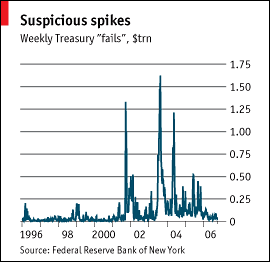
There is an article in the Economist this week discussing issues of concern to the Treasury. These concerns involve lending institutions from around the world which the U.S. is borrowing from. The treasury is concerned about the behavior of the banks we are borrowing from. This is largely due to the fact that banks can manipulate the market by restricting the supply of notes. One of the ways they do this is by "parking it with custodian banks." When there is less supply of the notes, banks can and often due profit by using them as collateral for loans. "They do this in the busy repurchase (repo) market, where treasuries are sold for cash with agreement to buy them back later. The scarcer the security you want to swap, the lower the interest rate you pay for the cash, known as the repo rate. On some issues this year the repo rate has fallen close to zero."
The treasury's concerns stem from the large amount of debt the U.S. currently carries. Increases in borrowing costs have more significant effects than ever before as a result. "Overnight money now costs 5.25% after 17 straight hikes." It is costing more and more to borrow which some banks believe it is justified in light of the 'risk' they are taking. Some however view this as “an exercise in monopoly pricing”. If a lendininstitutionon raises its interest rates, it is safe to assume many others have also taken that step or are taking that step at the same time; otherwise the lendininstitutionon would loose its customers.
The Treasury is very concerned with these movements because as mentioned before, "the market for its debt is the world's deepest and most liquid, with an average daily volume of $600 billion—many times more than America's share markets." Therefore behavior of banks is of enormous importance to the treasury, perhaps more than any other country in the world. It is also important to note that because the Fed implements monetary policy- it is expected to provide a "risk-free benchmark against which other credit is measured. If it is not squeaky clean, investors could turn tail, raising the country's borrowing costs."
Some argue that manipulating the market would be difficult because of its enormous size; consequently even a few adjustments should not have that big of an impact. Despite this the Treasury is still worried. Another concern is the "sharp increase in treasury settlement “fails” in the past few years, caused by a failure to return securities on time to the lender: these tend to jump when the repo rate is low and bonds are scarce."
There is also a concern of "history repeating itself" which is in "reference to the scandal at Salomon Brothers in the early 1990s, in which the investment bank was caught dodging rules on treasury auctions in order to gain control over certain issues". As a result, a joint surveillance program was introduced which says the Treasury, the FED and the SEC get together to "compare notes on the market". The Economist suggests that it's time for them to get tougher. It cites the recent downfall of profits for UBS which was caused by mistakes they made. "UBS which must now try to ensure that any bad smells at its bond-trading desk do not pollute other businesses, particularly its prized wealth-management arm. The bank delivered more bad news on October 31st, announcing a 21% drop in third-quarter profits. The cause was largely put down to poor trading: the bank admitted to, among other things, having been 'incorrectly positioned' in the treasury market." It is believed that if the Treasury, the FED and the SEC get tougher, there would be less suspicious increases in interest rates and problems like what UBS experienced would not occur because lending instituions would be more responsible.
Blue-Green Alliance
Friday, November 03, 2006
Social Security and Medicare Problems
However, under rational expectations this nominal change should be neutral. Looking more abstractly though, more simplicity in government is desirable. Over the long run, government would treat these promises of future benefits more like expenditures. Also, if these benefits are counted in the current budget as liabilities, it’s going to be harder politically to cut them out in the future. One easy way of cutting them out would be to tax them, which wouldn’t be hard to do. If one is in favor of tax hike, they would favor this proposal; however, if one would prefer spending cuts, they probably would not.
Social Security and other related items are big issues in our society today. I agree with those who think that these items are not only liabilities for the future but also promises, whether they will be kept or not. I understand of course why some people are opposed to this idea because of the potential raise in taxes, I don’t want my taxes increased as well. However, I think a possible solution to this is for the government to come up with a plan for Social Security and Medicare is to collect funds without having to raise taxes all the time. The government could figure out a way for there to be a set price and have the money go straight to Social Security or Medicare. I suppose some would oppose this idea though because it almost acts like a contract, since money will have to be “dished” out from now on to these issues. They should not be done away with though, so many people depend on them, the government just needs to come up with better ideas to raise money for them without always raising the taxes.
Tuesday, October 31, 2006
Assessing the Damages
Even if Phillup Morris is still found to be accountable for the husband's death, the question of how much should be paid is still debatable. The Supreme Court has already found that due process is violated if punitive damages are too high. The author of this article believes the damages awarded are not too high and calls into question the limitations previously placed on the amount of punitive damages by the Supreme Court. A few years ago, the court said that punitive damages should be in a '"single digit ratio to actual damages." For example if the damages were found to be around $500,000 the punitive damages should not exceed $5 million. The author contends that "Constitutional principles can seldom be boiled down to a formula and it is difficult to see why the court should rein in juries so tightly."
The author is failing to consider economic analysis in his answer. Economics contends the purpose of punitive damages in the end is efficiency- this is the primary goal and in order to achieve this one should be charged an amount equal to the damage done. If the amount is too high, efficiency will not be attained. In addition, using legal rules to redistribute wealth usually causes inefficiency. Courts should take into account estimated human capital such as future income, pecuniary damages and sometimes hedonic damages which is where most of the grey area lies because it involves putting a price on life. Putting a price on life is a task many are not willing to take because it involves a large amount of equity and subjective judgements because what one's life is worth to someone may not necessarily be the case to another. One would also need to calculate the compound interest and the rate one should use is also subject to debate because one cannot accurately predict what the future interest rate is going to be. There are many subjective judgements involved in calculating damages using economics but there are definite formulas and amounts exceeding what could reasonably be used in the formulas would not promote efficiency.
Punitive damages are a necessary part of both our economic and legal system. Punitive Damages exist in an effort to ensure individuals and companies are conducting themselves in a way that will cause little harm to others. Or economically speaking they would at least be willing to adequately compensate for such harm making the other party 'whole' again or internalizing the externality.
Generating Economic Freedom
Achieving higher per capital economic growth is possible even in low income countries. Research indicates that the best way for countries to increase economic growth is to adopt policies that promote economic freedom and the rule of law, both which are measured within the index of Economic Freedom. Countries that maintain polices that promote economic freedom such as monetary policy, provide an environment that generates trade and encourages entrepreneurial activity, which produces economic growth. Higher GDP growth rates are associated with improvements in a country's economic freedom. The more a country improves its economic freedom, the higher the average economic growth it experienced. Countries that consistently march toward improved economic freedom enjoy the most progress towards prosperity.
Why would economic freedom contribute to economic growth? With high taxation, corruption and trade barriers the country experiences a lag in economic growth. The more involved the government is in the economy the lower the chance that individuals, investors, and businesses will be able to gain because the costs of the private economic activity become higher. This tends to encourage specialized individuals to leave the country for better opportunities that do not contribute to GDP.
Providing assistance to a poor nation will not spur economic growth. Policies and institution is what should matter. Developing countries must create their own internal reforms by executing policies that encourage economic freedom. Unfortunately in many cases foreign assistance has dame development more difficult by encouraging corruption, and the continuance of bad policies.
Trade Disputes
How did HOAs get so powerful?
The donkeys are really cute. They look like the donkey from Shrek. Our neighbors rescued them seven years ago from an abusive home and they are afraid that the trauma of uprooting them will make it so they have to be put down. Our neighbors are going to fight the HOA and my mom and I have agreed to help in any way we can. But the whole situation got me thinking about Olson and what he would say about HOAs.I wondered how the HOA could become so powerful. I naively thought that HOAs were only concerned about the color of your house and if you left your trash cans out on the curb too long. How could my HOA tell our neighbors that they can’t have their donkeys when the area is zoned for horses? The HOA even said in their letter that just because donkeys were a member of the horse family it did not mean they were allowed just as wolves would not be allowed just because they are a member of the dog family.
The fact that the HOA has done nothing for seven years means something has changed. So, considering Olson I looked for a “bootlegger” and a “Baptist”. It turns out that our neighbors have had a feud going with our neighbors across the street. And it just so happens that our neighbor across the street is on the HOA board. And suddenly everything made sense. Our neighbor across the street was the “bootlegger” using the “Baptists” of the HOA to promote his own agenda. The “Baptists” in the HOA are concerned with falling property values. By their rationale if they let our neighbors keep their donkeys then what will stop other people from wanting to keep pigs, goats, etc. – animals that would detract from the enjoyment of the neighborhood and ultimately decrease property values?
However, none of this was an issue before the bootlegger was able to get the Baptists on his side. The members of the HOA are not a very large group but they are very latent. I doubt many of them even read the association bylaws let alone attend meetings and vote for the association officials. Since they are not very active in the association they are rationally ignorant about what the association is up to. This is slightly different from what Olson describes as a rationally ignorant voter because a member of the association could, if they so desired, influence the outcome of a vote (especially since so few members actually vote). However, because the cost of informed action to an individual member is likely more than the benefit they will receive, they are rationally ignorant.
For example, lawyers had to be hired to draft the letter to my neighbors. I’m sure many members of the HOA (including my mom) would rather see that money go to improving the park or some other productive venture. However, by not taking an active role in the HOA the neighbors are basically writing a blank check to those who do take an active role, like my neighbor the bootlegger. Having read Olson this is what I expect to happen. But, I still feel sorry for my neighbors and their two little donkeys. The abuse of power is just wrong whether it is by a bootlegger in an HOA or a roving bandit in destitute country.
Monday, October 30, 2006
Policy Economics
I read an article titled "Proposed Border Fence Could Face Environmental Obstacles in Texas." U.S. Congress approved a homeland security bill that would palce a fence along about 700 miles of the U.S. border with Mexico. The purpose of the fence is to control the flow of illegal immigration across theh U.S. Mexico border. The problem is that the plan could destroy habitats and cut off access to water for numerous animals, including the endangered ocelot and jarguarundi, ancestors to the bobcat. To assess this problem you have to compare the costs and benefits of a fence towards the immigration problem and toward the endangered species. The costs of the fence would be funds for construction, disturbance of economic traffic between border towns of the U.S. and Mexico and possible extinction of certain species. The benefits of a fence would be less illegal activity allowing the most vulnerable sectors of our poputlation better chances of succes. A fence could benefit by keeping public funds to those who pay taxes, thus giving future Amercias educatoin, health care, and retirement security. Addtionally the stress of overpopulation, straining natural resources like wter, energy and forestland, would not be present. The costs of putting up a fence for certain species could mean extinction. Gene pools could be altered because of lack of contact with the same species and the food chain could be altered. Benefits towards building a fence are hard to come by unless an interest group implements some type of policy that provides money to reallocate as much of a species to a designated plot of land, not much can benefit from the fence species wise. I think that building a fence will benefit society better than leaving an open boarder. Will the contiuation of the Ocelot species continue life for me? Can i live without the Ocelot? I believe i can and i believe that the problem with illegal immigration is far more important than that of the endangered species along the Mexican/Amercian border. But if people recieve some benefit or incentive from these animals then they should be active in making a policy decision that would allow for both to occur.
Policy Economics
I read an article titled "Proposed Border Fence Could Face Environmental Obstacles in Texas." U.S. Congress approved a homeland security bill that would palce a fence along about 700 miles of the U.S. border with Mexico. The purpose of the fence is to control the flow of illegal immigration across theh U.S. Mexico border. The problem is that the plan could destroy habitats and cut off access to water for numerous animals, including the endangered ocelot and jarguarundi, ancestors to the bobcat.
To assess this problem you have to compare the costs and benefits of a fence towards the immigration problem and toward the endangered species. The costs of the fence would be funds for construction, disturbance of economic traffic between border towns of the U.S. and Mexico and possible extinction of certain species. The benefits of a fence would be less illegal activity allowing the most vulnerable sectors of our poputlation better chances of succes. A fence could benefit by keeping public funds to those who pay taxes, thus giving future Amercias educatoin, health care, and retirement security. Addtionally the stress of overpopulation, straining natural resources like wter, energy and forestland, would not be present. The costs of putting up a fence for certain species could mean extinction. Gene pools could be altered because of lack of contact with the same species and the food chain could be altered. Benefits towards building a fence are hard to come by unless an interest group implements some type of policy that provides money to reallocate as much of a species to a designated plot of land, not much can benefit from the fence species wise.
I think that building a fence will benefit society better than leaving an open boarder. Will the contiuation of the Ocelot species continue life for me? Can i live without the Ocelot? I believe i can and i believe that the problem with illegal immigration is far more important than that of the endangered species along the Mexican/Amercian border. But if people recieve some benefit or incentive from these animals then they should be active in making a policy decision that would allow for both to occur.
Saturday, October 28, 2006
Global Corruption
World GDP Statistics


ANGUS MADDISON seems to be the go-to economist when it comes to world GDP numbers. You may be interested in checking out his homepage which includes a link to an Excel spreadsheet that provides population and GDP figures for the period 1-2003 AD.
I've used his spreadsheet to create several charts of per capita GDP data you might find interesting. You can click on a chart to get a larger version.
Saturday, October 21, 2006
The Logic
"When will we know that liberal dominance on campus has truly ended? When conservative and libertarian students engage in as much free-riding and factional in-fighting as liberal ones do today:)!"Read the whole thing.
Would you agree?
Tuesday, October 17, 2006
Kleptocracy
Today, The President Unveiled His National Strategy To Internationalize Efforts Against Kleptocracy, Pledging To Confront High-Level, Large-Scale Corruption By Public Officials And Target The Proceeds Of Their Corrupt Acts. This Strategy Is A New Component Of His Plan To Fight Corruption Around The World. Public corruption erodes democracy, rule of law, and economic well-being by undermining public financial management and accountability, discouraging foreign investment, and stifling economic growth and sustainable development.
Thursday, October 12, 2006
Today's Wars
In all these countries, civil war is the main cause of conflict. The usual trigger is a dispute over scarce resources, or territory that has changed hands in the past. There are no traditional "invasion" type wars going on at the moment. However, some of the conflicts involve the use of irregular troops to "invade" a neighbor and try to conquer disputed territory. This is the case in Kashmir, where Pakistani irregulars have been invading this disputed territory, trying to take it from India. Another example is Darfur, where Arabic Sudanese tribes chase black African tribes out of disputed territory. A major threat of war these days comes from China, which threatens to take Taiwan by force, and uses nationalism and military threats to try and control neighbors.Read the whole piece. Note the reference to warlords. You may want to consider this when we take up Power and Prosperity and discuss the idea of roving bandits.
Many current conflicts arise from the ease with which one can establish a private army. Calling the leaders of these forces warlords is pretty accurate, as these guys live off war. Stealing, or extorting, what they need, these groups have flourished on the availability of cheap Cold War surplus weapons from Eastern European and Russian arsenals. Africa is awash in warlords, with armed groups controlling turf all over the continent. The violence in and around Israel is largely because of warlord organizations like Hamas and Hizbollah, which are funded by Moslems seeking to destroy Israel.
Georgia
"The past week was a trying one for Georgia. Air, rail, sea, land and postal links were severed unilaterally by our largest neighbor, the Russian Federation. Immediately thereafter, Georgians living in Russia were subjected to a form of ethnic targeting not seen in Europe since the Balkans in the 1990s--and the harassment is tinged with even more sinister historical overtones. Hundreds are being deported; business owners are being harassed; schoolchildren are being forcibly registered with local police; women are being gratuitously tested for sexually transmitted diseases; and children are being torn from families.
It is easy, amid these bleak headlines, to lose sight of an even more important story: In just three short years, my country has been transformed from a gangster-run economic and political basket case into a budding democracy with one of the world's fastest-growing economies. The World Bank recently lauded Georgia as the No. 1 reformer in the world and the least corrupt transitional democracy. Just last month NATO admitted Georgia into a new stage of membership talks, recognizing our political, economic and military progress. And just last week we completed an action plan with the European Union that charts our irrevocable course toward a fully Western future.
It is this remarkable metamorphosis--capped last week by fully fledged, free and fair local elections, hailed by the Organization for Security and Cooperation in Europe (OSCE) for their "professional and inclusive manner"--that gives us strength in this moment of crisis. All of our gains have been hard-fought. Our citizens have long suffered privations, and only now are tasting the sweetness of liberty: the opportunity to vote, to lead fruitful lives, to speak their voice, and to chart a future for their children untrammeled by poverty, mafias or discrimination."
Saturday, October 07, 2006
The J-curve and The Rise and Decline of Nations
Why Nations Rise and Fall, by Ian Bremmer. In the book, Bremmer plots authoritarian states on the left side of the J, and democratic states on the right. He argues that very authoritarian states on the top of the left side of the J must, in order to liberalize, descend through increasing instability at the bottom of the curve and then ascend on the right. As they ascend the right side of the J, the states will see less instability. The process can also happen in the reverse direction, and states can become mired in the middle of the curve.
This strikes me as an interesting idea, particularly given the discussion we had in class of Olson's Rise and Decline. In Olson's theory, the more stability in a state, the more organizations have evolved which rely upon and promote that stability. He even uses the word sclerotic to describe the state of Great Britain in the early '80s. I suspect Bremmer would put Great Britain all the way at the top-right side of the J. Conversely pre-war Japan and Germany would have been placed near the top of the left side -- their defeat dropped them to the bottom of the curve, and then they clawed their way up the right.
The period of highest growth for Japan, Germany and the UK were probably as they completed the 'turn' onto the vertical part of the curve. South Korea and India seem to be making or to have just completed this turn as well. I suspect Iraq is at the bottom of the J, with the potential to go either way. And China, as the reviewer, Tim Worstall, points out, seems to straddle the curve; politically on the authoritarian side, and economically on the free side.
Friday, October 06, 2006
Scientists and Engineers for America
"Today a group of scientists and concerned citizens launch a new organization, Scientists and Engineers for America, dedicated to electing public officials who respect evidence and understand the importance of using scientific and engineering advice in making public policy.Hmmm. Very interesting, eh? What do you think? What is the probability that a group of people, even a group of scientists, will speak honestly about science, or anything else, after forming a political interest group?
The principal role of the science and technology community is to advance human understanding. But there are times when this is not enough. Scientists and engineers have a right, indeed an obligation, to enter the political debate when the nation’s leaders systematically ignore scientific evidence and analysis, put ideological interests ahead of scientific truths, suppress valid scientific evidence and harass and threaten scientists for speaking honestly about their research."
I think I detect "bootleggers" here. Who are the "baptists" that are going to join in their cause?
Wednesday, October 04, 2006
Forests and owls
I found an article entitled "Why Endangered Species Protection vs. Economic Development doesn't Have to Be a Win-Lose Scenario." The article focuses on the effect of the federal endangered species act had on logging mills of the Pacific Northwest during the mid 90's. The problem facing these loggin mills came about through the spotted owl which was listed as one of many endangered species. The spotted owl needed old growth forests for their habitat, yet the loggers maintained their lives with the favored old growth timber which yielded more profit because of the size. Substantial restrictons on old growth logging eventually resulted in 15,000 forest-related jobs lost. These jobs that were lost, according to the results of the Clinton Administration efforts were replaced with jobs in businesses in other sectors such as technology, and other skill-laden opportunities in diverse fields. The unemployment rate was low and owls and old growth were being protected. A perfect comprise right? To keep the old growth trees standing would be efficient and not only by preserving the spotted owl. Lets say the loggers are allowed to keep cutting the old growth timber. The problem arises when you run out of that type of timber. Once the logger exhaust the timber he can't think that planting more trees will yield the same type of profits recieved before because the time to create old timber will exceed the life present logger if planted now. He would not be able to see the maximum net benefit. The problem arises with if whether or not each logger that lost his job was rewarded with a new one that provide equal economic benefit. The article states that 20,000 jobs were gained but by who? If one logger benefitted while one did not this creates a market failure and an inefficient means to providing protection for the spotted owl. Job placement must be obtained in order for this type of policy to work efficiently.
Property rights, Collective action, and Agriculture
Monday, October 02, 2006
Indian Gaming
Recently proposals have been made by Senators to update the 1988 Indian Gaming Regulatory Act put in place by Congress. The Indian gaming industry has experienced excellent growth since the law was enacted. In 2005 the industry raked in almost $23 billion dollars. This growth has led other tribes to attempt to try and find land that is rightfully supposed to be theirs and establish their own gaming enterprises. The proposed amendment is supposed to halt off-reservation casinos as well as tighten the reigns that government has over the industry. If the amendment were to be approved the National Indian Gaming Commission would have the ability to then regulate the industry. Some tribes are concerned that the stiffer regulations on their accounting and other internal control standards would significantly increase their operating costs. If this were to happen they would be potentially forced to let go of some of their workers. Arrangements have been made by Rep. Pombo in order to specifically allow the Ewiiapaayp-Viejas Project. It is said that most of the Indian Country already approves of the current regulations in use.
Something about this proposed amendment seems fishy. If most of the Indian Country approves of the current regulations one wonders why it is that they would want to have more regulations enforced. It seems possible to this author that there could be at least two possible groups that may want this change to occur. The first could be gaming enterprise owners that operate off of reservations that are subject to the taxes and government intervention that the tribal gaming enterprises are not. The second could be tribes with representation that possibly want to just make it more difficult for other tribes to enter the industry, possibly taking a portion of their market share. One would guess that there are probably some funds that were transferred to Rep. Pombo to keep the Ewiiapaayp-Viejas from being voided by this amendment change. It will be interesting to see if this proposed changes between now and the time something actually happens in Congress. One can rest assured there will be ever more lobbying done in the near future by the tribal gaming groups.
The perfect compromise
To keep the old growth trees standing would be efficient and not only by preserving the spotted owl. Lets say the loggers are allowed to keep cutting the old growth timber. The problem arises when you run out of that type of timber. Once the logger exhaust the timber he can't think that planting more trees will yield the same type of profits recieved before because the time to create old timber will exceed the life present logger if planted now. He would not be able to see the maximum net benefit.
The problem arises with if whether or not each logger that lost his job was rewarded with a new one that provide equal economic benefit. The article states that 20,000 jobs were gained but by who? If one logger benefitted while one did not this creates a market failure and an inefficient means to providing protection for the spotted owl. Job placement must be obtained in order for this type of policy to work efficiently.
Sunday, October 01, 2006
Brazilian Rainforest
The government only has a role to play if the rainforest is a public good that will otherwise not be provided, or if there is an externality. I’m sure there are some goods that are provided because of the forest, and I am sure the rainforest will diminish a lot faster without the government’s intervention, but I am not positively sure if there is an externality. There may be a positive externality that comes from rain forest protection. Many people benefit, or live their lives within the rainforest. Many of these people also benefit from cutting down the rainforest because they can make a living from it, so I don’t believe this is a positive externality. But, their may be a positive externality that results from the value of preservation, especially in preserving something like the Amazon. If there is not enough rainforest protection, which would be the case if there is a positive externality, than the government would be reasonable in protecting the forest.
Collective Action and the Rise of Transnational Institutions
In the Logic of Collective Action, and later in chapter 2 of The Rise and Decline of Nations, The author writes about the difficulties that arise when individuals organize and attempt to pursue conjunct or collective action. As he states, "[a]nother problem in organizing and mantaining socially heterogeneous groups is that they are less likely to agree on the exact nature of whatever collective good is at issue or on how much of it is worth buying" (Rise 24). This fundamental issue is at the core of the difficulties of true collective action and the theory proposed by Olson. The nation-state system of politics that has dominated the international scene since the Treaty of Westphalia (1648) was initially characterized by the interaction of mostly homogeneous units (nations) but the domestic politics of nation's themselves have experienced an evolution toward more pluralist units. This falls in line with Olsons work in the Rise and Decline of Nations. As the second implication of chapter 3 indicates, "[s]table societies [...] tend to accumulate more collusions and organizations for collective action over time" (Rise 41). This finding explains the process by which nation states become more pluralist over time.
Governments around the globe, once they have undergone the process previously described, become less efficient and less adept to manage the requirements of their citizens. This happens as a result of what Olson describes in his ninth implication on chapter 3, "the accumulation of distributional coalitions increases the complexity of regulation, the role of government, and the complexity of understandings, and changes the direction of social evolution" (Rise 73). In this quote, the 'distributional coalitions' refer to different interest groups that aim to (re)distribute collective resources in a manner that most fits their best (individual)interests. In the example I am using, those coalitions would be the interest groups within nations that want 'a larger' piece of the national 'pie.'
Modern transnational institutions are gaining importance as vehicles for individuals to attain their larger shares of societal wealth, assuming a role previously reserved for nation-states. Gradually, citizen's around the World are relying more on transnational, non-governmental, organizations instead of their own national governments. Richard Mansbach, a political scientist and proffessor at Iowa State University, explains this phenomena as partly related to the "erosion of state capacity"(Global Politics in a Changing World 184). Increasing ineffieciency at governmental levels, in addition to advances in technology that have made transnational resources more accesible, have changed people's perception of community and changed forever the alternatives available for their natural 'self-serving' quest. Author Jessica Mathews writes in her article Power Shift, " nation-states may no longer be the natural problem-solving unit"(Global 184). The effectiveness of transnational organizations is often derived from the fact that they act in a very autocratic manner. P.J. Simmons, in Learning to Live with NGO's, explains: "NGOs operate outside formal frameworks, moving independently to meet their goals" (Global 198). However, as organizations, they come to be under the same process that Olson describes in the Logic of Collective Action, just as the traditional nation-states did. They are subject to the same evolution and the same arising complications. Mathews points out, "[d]edicated to promoting more openness and participation in decision making, they [NGOs]can instead lapse into old-fashioned interest group politics that produces gridlock on a global scale"(Global 197).
As the logic of Olson explains, the 'decline' of the new global system of transnational organizations is inevitable as the workings of collective action continue to shape the evolution of individuals and the social,economic and political systems in which they operate. The same technological adavances that ended "governments' monopoly on information" and changed "people's perception of community," will likely continue to be the shaping force of change for global political systems. Especifically, ever increasing access to the World Wide Web (or internet) has dramatically changed the 'costs and benefits' of attaining and transmitting information, as well as of contacting and organizing with people beyond traditional social circles.
In the Rise and Decline of Nations, Olson provides the following quote: "The limited knowledge of public affairs is in turn necessary to explain the effectiveness of lobbying. If all citizens had obtained and digested all pertinent information, they could not then be swayed by advertising or other persuasion" (Rise 26). As individuals gain greater access to information they will naturally become less reliable on their usual channels of collective action.
If Olson's logic is followed, as this entire essay attempts to do, the eventual decline and/or transformation of the new transnational system of NGOs is inevitable. It is interesting to speculate about how this transformation would occur and what the new emerging system would be like. Is the erosion of the nation-state paradigm transitory? Will a new type of collective organization arise? My understanding of Olson's work may not be sufficient to elaborate a guided 'guestimation' of how the evolutionary process of collective action and global politics will turn out; for now, this posting served as an interesting exercise for the application of the first few assigned chapters of the Rise and Decline of Nations.
Saturday, September 30, 2006
Global Solution to Poverty? Part 2
"This point bears repeating. Poverty has no causes. Wealth has causes."
I think if we are to take this quote into consideration we must go back to Olson's Logic of Collective Action. Both poverty and wealth have causes, what seperates them is the mentality of a large lantent group that finds a way to organize itself and become the upper class versus the group that see's nop reason for persuing anything beyond the bare essentials.
"A world characterized by "poverty" as we think of this term today really is the default position, or it really can be thought of as the starting point. It is the creation of wealth that means people can escape from poverty. People will make the choices that create wealth if government acts to enforce private property rights and contracts, and further if government avoids supporting predatory activities, people will prosper all that much more."
It is usally these nations that are plagued by war, disease, and the constant state of governament changing hands quite frequently that are said to live in poverty. I would have to agree that for the most part, poverty is the "default" mode for many of these types of countries. We can see several example from around the world of volital rise and decline in living standards. We can also see several countries around the world with an ever growing uneven income distribution. It is in this inequity that that the problem lies. But then we are left thinking, how do we distribute the income more evenly? By looking at the above quote we can see that it is all a problem of motivation. Within these poverty stricken countries it is nearly impossible for the comman man to own any private property without the new government in power siezing it. It is nearly impossible for the comman man to take any legal action against another because of the ever changing laws. The comman man in these countries amounts to a large latent group with neither the power or the desire to mobilize to achieve a common good. By the government supporting predatory actvites and not taking control of their nation, they are keeping their own citizens in the horrible poverty that has plagued them for centuries.
This takes us back to a recent class discussion and chapter 3 in The Rise and Decline of Nations. Olson talks about how a firm (or in this case a government) has two options when trying to obtain more wealth and income. It can either 1. enlarge the entire economic pie and therefore create for wealth for the entire society, or it can 2. choose to enlarge only it's piece of the pie. What the governments in these poverty stricken countries has choosen to do is enlarge only their share of the pie. Why? First of all because it requires less input and resources than it would to enlarge the entire pie. It is by far less costly and less of a daunting task to act rationally and only be concerned with how much you are recieving of a collective good. Second, if Olson is correct in his definition of rationality, a rational person would not want to provide a collective good for the entire society because he would get only a small part and would most likely have to put far more time and energy into achieving the collective good than a majority of the others who also recieved it. So by this logic, it is much more rational for those in control of these poverty stricken countries to act in the opposite way of what would actually benefit their people.
So how do we comabt this so called rationality? We find a new form of government for these nations. Here I would have to agree with Sean that we cannot hope to transfer our political ideals without our economic ideals as well. The only problem here is that, as the U.S. has found on a couple of occasions, is that not all other cultures support our ideals and our values. Democracy gives rise to materialism and wealth, but this is not something that all other nations value. This is why I think it is important that we keep economics and psychology close together. Further more it is impossible for those nations that have capitalism forced upon them to experiance the idealism that our nation felt when democracy and capitalism joined together. Even if we could force capitalism onto these poverty stricken nations would we really want to? Would we really want to force upon them the red tape, the beaurcracy, and the snake of corruption that has somehow become intertwined in our government? It is through these things that many dictators can take a guise of capitalism and turn it into a perverted authoritarian nation. We are potentially heaping upon these nations just another period of revolution and war.
Finding the right government to match a certain culture of people is indeed a dauting task; that is why many countries are still plagued with poverty today. They have all tried to make better lives for themselves and to oversome the opression, but without the correct form of government to provide the right incentives, all we have is several nations ending up back in their "default" mode. To borrow a few words from Olson, it will take a strong leader and the right circumstances to pull these countries out of opression. Until then they will remian in their "default" mode of poverty.
Pygmies
In my anthropology class last semester we read a book entitled, The Forest People. It was written by an anthropologist named Colin Turnbull that lived and worked with the BaMbuti for several years. The BaMbuti live in small band level groups of about 30-50 people throughout the African rainforest. They are nomadic hunter-gatherers; their primary economy is net hunting (and by “economy” I mean a way to make a living – in this case food). Net hunting is among the earliest economies and is unique in that all members of a society take part. The men from each nuclear family set up the nets to form a large, continuous half circle in a particular area of forest. The women and children form a line a ways off and then start shouting and beating the underbrush with sticks to drive the animals in the direction of the nets. Once caught the animals are quickly dispatched, taken back to the temporary village and butchered. The meat is distributed among all of the families regardless of whose net actually caught the animals.
The BaMbuti live in extended family groups. One man’s family was too small to survive on its own and so had attached itself to the group that Turnbull was studying. One day Cephu decided to secretly set up his net in front of the other nets. This was not very efficient. Cephu was able to catch some animals, but the position of his net deflected most of the animals away from the other nets. When the villagers returned home after a disappointing day they found Cephu trying to hide his spoils.
By setting up his net in front of the others Cephu wanted to enlarge his “piece of pie”. He didn’t want to be limited to what was doled out after the collective hunt. In so doing he effectively made the pie smaller for everyone else. Olson would say that Cephu’s decision was logical so long as the cost of the action did not exceed the inverse of the fraction of the group represented by Cephu’s family. Turnbull did not include specific population data so I can’t say for certain that Cephu’s decision was logical according to Olson. However, empirically it seems his decision was not logical. Once the group realized what Cephu had done they confiscated his meat and redistributed it to the rest of the group leaving Cephu’s family without food for the night. (Perhaps if he had not been caught then his decision would have seemed more logical.)
The BaMbuti live in small groups and like any group they have to deal with the problem of free-riding. They offer a collective benefit in the form of meat from group net hunting. To prevent free-riding and other socially unacceptable behaviors (there was a very interesting part involving incest) the BaMbuti have strong negative incentives. The punishment for the gravest of crimes is banishment. For the BaMbuti banishment is death. A lone person or a lone family cannot hope to survive on their own. The threat of banishment helps keep the group together and ensure that everyone does their part.
Starting Over in New Orleans
Global Solutions to Poverty?
"Poverty is caused by the exploitation of the working class by the wealthy. The rich obtained their exalted status by stealing their money from everyone else. The solution is simple: the confiscation and redistribution of existing wealth, followed by high taxation and a strong social safety net to keep such inequalities from re-occurring. No one in Sweden is poor, and no one would be poor in America if we had the same laws and protections here."
After taking a look at the income inequalities through a few nations (http://faculty.tcu.edu/jlovett/econ_data/Income%20Dist.pdf#search='US%20income%20distribution'), we can see a somewhat interesting trend, and one which Olson's work would have predicted. The US is not the number one rank of income inequality, but a look at those who outrank us does not provide much hope. Of the 14 nations with a less equal income distribution than us, 12 are essentially banana republics of South America, whose democratic history was one born of violent conflict resulting from the cold war. I cannot doubt that poverty is the natural state, but when looking at this issue in terms of political-economy, I struggle to find the solution to this problem. Even if our efficiency based model is the best chance the world has for escaping the natural state, how can we actually think that our system of government is the best, or even worthy enough to transplant? I believe Olson would have said that we cannot expect to transfer our economic model without our political model following on its heals. The only problem is that when we go to deliver democracy to a developing nation, they are not getting the same revolutionary period of fundamental idealism, but rather the democracy that we have now, one characterized by rent seeking (Olson states that as time passes, rent seeking tends to increase). Taking this into account, could anyone doubt that the rent seeking will spill over into the field of foreign issues? No matter what one thinks of the Iraq war, the very fact that the Vice President's former company is entirely responsible for the re-building effort provides strong evidence for this outcome.
This is not to say that only capitalist nations are to blame. In one class, we discussed the government that was open to outside bribe versus the one that was not. China, though moving towards economic freedom, is by no means a totally open economy, yet they rank just two positions behind the US in inequality. This must surly be an indication that even in a government that is, at minimum, subject to fewer pressure groups can still be just as corrupt. This is not to imply that disproportionate income nessicarily means corruption, however, by simply following Olson's theory, we must recognize that by the simple fact that both the US and China have stood for a long enough time period that we would predict rent seeking. I think the heart of this issue comes directly from Olson's work Logic, which makes the point that even though we may have very idealistic hopes for our social programs, the bureaucracy of achieving the end will ultimately be corrupted and ineffective. Can we not expect the same outcome from nation building? Does the model we hope to implement have any chance of escaping the mass corruption and can any political-economic system established by a foreign power truly succeed if the people prospering are mainly from said foreign power?
Friday, September 29, 2006
Poverty Is The Default Position
"A world characterized by 'poverty' as we think of this term today really is the default position, or it really can be thought of as the starting point. It is the creation of wealth that means people can escape from poverty."
Wednesday, September 27, 2006
A Fable of Collective Action
The first one that came into my head was The Little Red Hen. Click the link to refresh your memory of the story. It seems to me that this little fable explains the problems of the small group that Olson mentioned. The group is small enough that one individual, the Hen, could act to provide a collective good for the group, without the participation of the other members. The free-riding by the Duck, the Cat, and the Dog did not really hinder the Hen's provision of the good. On the other hand, the group was not large enough for the free-riding to go unnoticed or unpunished.
Perhaps the Hen should have made it clear that the bread was not a collective good, but rather a selective incentive, from the start. Had she said "This wheat should be planted, who will help me and share the bread?," she would have saved herself some toil and motivated the group to help.
Tuesday, September 26, 2006
"The Limits of Solidarity"
Unions are fighting back with the Employee Free Choice Act which would "stiffen punishments for employers who intimidate workers trying to form a union; mandate third-party arbitration and unions if bosses cannot agree on a contract; and it would get rid of secret ballots as a prerequisite for union recognition." Unions propose a "card-check" system which requires employers to accept unions if a majority of their employees say they want one. The argument for the card-check system is problematic because it opens up the door to intimidation, bribery, and coercion by both employers and unionists. Public opinion is not conceding this problem so unions are turning to "corporate campaigns designed to pressure firms into allowing unionization by card check." They have already accomplished this goal with Cingular Wireless and Unite Here by publicly attacking the firms.
Despite the success of unionists in limited areas union membership is still on the decline. Which is partially the result of the unions ability to provide the same reliable incentives to workers as it was previously able to- "Unions can no longer protect against job losses, as Detroit's carworkers know only too well." In addition the ability of private firms to provide the same services as unions has also had a negative impact on membership. "Sophisticated human resource departments now allow employers to replicate many of the unions' traditional functions such as dealing with workers grievances."
I am against the restriction of individuals ability to be able to form and participate in any group they wish as long as it does not cause harm to someone else. However, sense unions have the coercive force of government behind them, they are more of a hindrance to the market and to those very individuals that are participating in them. When unions force wages to increase, it has to be paid for, the money has to come from somewhere. If the wages are increased in service industries, the price would be passed on the the consumer which would presumably hurt the disadvantaged. Americans seem to be understanding this phenomenon "the share of American workers carrying union cards has plunged from over 20% in 1980 to under 13% in 2005." In America, membership in unions is decreasing which seems to be a global trend across many wealthy countries.
Wednesday, September 20, 2006
Voter Apathy
I guess that makes me an irrational person because I voted in the last election. Of course that was before I read The Logic of Collective Action. However, even knowing what Olson says about large, latent groups and agreeing with his theory I will still vote in the upcoming election. I will vote because, for me, voting provides some noncollective benefits. When I vote I feel I have fulfilled my civic responsibility. For me the benefits of voting outweigh the costs. But then again, I grew up in a family that talked politics over the dinner table. When I turned eighteen, I was expected to vote. And I did. But not everyone grows up with the same expectations. Those people who are not taught civic responsibility at home must learn it somewhere else or not at all. Most people encounter the concept of civic responsibility during the course of their education. But more and more, it seems to me, the education system is teaching our youth to be free-riders when it comes to exercising their civic responsibility.
Class sizes are steadily increasing from grade school to college. This trend is easily understood from an economic perspective. At relatively small numbers as class sizes grow, overhead expenses such as buildings (and teachers if one assumes that a teacher can as easily teach fifty students as fifteen) remain relatively fixed and the marginal cost of teaching an additional student falls. However, as the class becomes larger, the contribution of each individual student to the class as a whole falls. When the teacher asks for a volunteer to work a problem on the board the pressure to volunteer and participate is less than in a smaller group. Thus it is easy for students who do not prepare for class or students that need extra help to go unnoticed in larger classes.
Conversely, in small classes, like ours, each individual’s contribution is proportionately greater. People who do not prepare for class find it more difficult to go unnoticed. It is easier to weed out free-riders and punish or “incentivize” them appropriately. Large classes set the expectation of free-riding whereas small classes set the expectation of participation.
I know that the incentive to free-ride is not a learned behavior per say. But meeting expectations is a learned behavior. Whether it is paying bills on time or voting, most people do what is expected of them even when it imposes a cost. If we expect our youth to free-ride – to sit in the back of the classroom and let the “smart” kids carry the load – then what will they do later in life when it comes time to exercise their civic responsibility?
Thursday, September 14, 2006
Gay Groups
Thursday, September 07, 2006
Stationary Bandit
Wednesday, August 30, 2006
Tuesday, August 29, 2006
Stationary Bandits
I wish that each government would on its own refuse to inflict trade restrictions on its subjects. But that's not what governments do. At root, governments are stationary bandits, skilled chiefly at creating and extracting rents from innocent people.