Developing countries never explicitly shook one approach over the other, there seems to be noticeable differences between poverty reduction and wealth creation. In paved reduction focused countries, such as Madagascar, or Mali, systems tend to operate under a culture of control, monitoring, and bureaucratic procedures. Concern is put on socially oriented cost centers and manageable checks and balances to monitor those cost centers. This may look good interms of consumer confidence, but it is inefficient in terms of market responsiveness and competitiveness. Little effort is channeled towards income generating business activities, and managerial time and focus is on securing grants, rather than crating wealth. Very few companies survive on purely market driven business models, and when they try to , basic government services are not there to support them.
In wealth creation focused countries such as Singapore or Mauritius, we see a tighter relationship between business and government. Leaders from both aids have a clear sense of the ir respective roles in the wealth creation process, and leaders on both sides are rewarded accordingly. As a result, organizations in such countries tend to directly or indirectly focus on supporting business. Public sector managers are asked to express clear and measurable wealth creation support objectives, and to claim the resources they need to achieve these objectives. Agencies in charge of critical income generating sectors become important agencies that work closely with the private sector and get priority support from other government departments.
Where does this leave a country like Rwanda? It might help Rwandan public and private organizations be more conscious of the choices they inherently make every day. Aid-funded organizations that directly provide relief to the poor are necessary and will be needed in Rwanda for many years to come. However, it will be critical that Rwanda finds more sustainable ways to finance them. In the meantime, it is imperative for most other organizations to examine how their activities directly or indirectly contribute to the wealth of the nation.
there are huge potential economic benefits from income-generating sectors like coffee and tourism. It is estimated that investments of $80 million and $100 million could, coffee and tourism could generate around $580 million in badly needed export receipts. Not to mention the thousands of jobs these high economic impact industries would create in the Rwandan economy. If these targets were achieved they would fundamentally transform the economy.
Rwanda's path towards more competitive coffee and tourism industries will not be an easy ride, and the Rwandan public and private sector coffee and tourism leaders who have developed precise action plans for those industries all know that. Both they also fell that the risks and investments required are will worth the risk. The prospect of slowly crating prosperous coffee and tourism businesses in Rwanda is becoming more and more obvious and the country's stated goal to reduce reliance on foreign aid could eventually become a reality.
Wednesday, December 13, 2006


Thursday, December 07, 2006
Islamic banking
Islamic Banking
In accordance with Shariah (Islamic Law), Muslims cannot charge interest. This is a very detrimental law or rule to Islamic Banking systems and Islamic countries. Markets are everywhere, and there is no doubt that Islamic countries benefit from transactions in a market. But, I don’t think an Islamic country can come close to benefiting from the full potential of the market without allowing interest rates. In Mancur Olson’s book, Power and Prosperity, Olson suggests that a country needs a full range of markets that will allow the society to capture the most gains from all types of transactions. Olson gives an example: Suppose there is a young man that is interested in starting some type of business and he is fully willing and capable to make the business prosper, but he has no money. Now suppose there is an older man that has the money, but is not enthusiastic enough or willing to start his own business. Both men, the economy, and the country have a potential to become better off if the older man loans the younger man the money. But, the older man will not do this unless he is sure that the young man will not just keep all the money for himself. An enforceable contract (with interest added in) will allow this type of transaction to take place. I think there is a lot of room for more advantageous transactions and economic growth in many Islamic countries, if they are willing to take advantage of it.
Policy Economics
Policy Economics The article i read was called "Hatcheries In Crisis." It stated that National Fish Hatchery System true federal role is hleping endangered species and native fish. The problem arises when talking about what constitutes an endangered species? According to the ESA if a fish can be included into the same distict population segemnt as the wild fish in ewhich they are genetically associated with, then they must be listed togheter. This is not the case with fish produced in hatcheries. Hatchery fish can be difined as fish fertilized or grown artificially in a production or conservation hatchery. Unfortunately these types of fish show domestications effects such as genetic adaptations to hatchery environments that are genrally maladaptive in the wild. Hatchery fish usually have poor survuavl in the wild and altered migration and feeding behaviors of natural fish. Hatchery fish also are typically larger and tend to compete with wild fish. Ultimately artificial fish of this type can overrun the wild fish type, driving the true wild fish DNA strand out of existence. How can conserving a fish species be done without altering its gentic makeup? One plan that could be implemented would be to create an sizeable environment for fish such as a private pond or lake , that produces food for its fish on its own, has areas inwhich breeding could be done naturally between fishes, and has no human contact(except for fishing season). Then wild fish could be caught and placed into these areas allowing them to develope into many. Once breeding season finished, fish then could be caught up to a certain ammount that fits the sustainable ammount in the pond.
Wednesday, December 06, 2006
Nigeria: Case Study
The African nation of Nigeria has long been a case of interest for the study of political and economic development. This country is a great example of a post-colonial developing nation and its developmental history contains very important lessons about the political and economic retardation of the developing World.
With a population of 130 million people and a total area of almost 360 thousand square miles, Nigeria is the most populous nation in Africa and ranks amongst the ten largest in the World. Nigeria's population in West Africa, its size, and its oil-producing status have made it the hub of regional economic activity. Demographically, it dwarfs the other fifteen countries in West Africa with a population that is about 60 percent of the region's total. Also, Nigeria's gross domestic product (GDP) represents more than half the total for the entire subregion.
Nigeria was a British colony until 1960 and the colonial experience left a powerful imprint on the design of the African nation. Darren Kew and Peter Lewis summarize the comparative significance of Nigeria:
Nigeria offers, within a single case, characteristics that identify Africa.
These opposing forces are rooted in the constant struggle in Nigeria
between authoritarian and democratic governance, the push for develop-
ment and the persistence of underdevelopment, the burden of public
corruption and the pressure for accountability (Kesselman 515).
The reality of modern Nigeria represents a very common case in Africa; its boundaries have little to do with the borders of precolonial African nations, instead, these boundaries merely mark the point where British influence ended and France's began. The geographic design of the African colonies corresponded to the interests and convenience of their ruling powers and not according to any cohesive concept of race, ethnicity, demographics or natural geographic divisions. In addition, the British played off ethnic and social divisions to keep Nigerians from developing organized political resistance to colonial rule, and where resistance did develop, the colonizers did not hesitate to emply repressive tactics. The British ensured that ethnicity would be the primary element in political identification, mobilization, and competition. In the words of Kew and Lewis, "Nigeria, like all other African countries, has sought to create a viable nation-state out of the social incoherence created by its colonial borders" (Kesselman 516).
As a result of its colonial legacy, Nigerians have been unable to form a true national identity around which the citizenry could rally around and develop stable political and economic institutions. Since their independence in 1960, Nigerians have witnessed six succesful military coups, one violent Civil war, and the design of nine different constitutions. The modern republic of Nigeria has supposedly adopted a model of "federal democracy" as a strategy to ensure national unity; however, as a concequence of many years of colonial and military rule, a unitary system emerged: a system with an all-powerful central government surrounded by weak and economically insolvent states.
Political instability and undervelopment has been accompanied by economic instability and underdevelopment. Despite being endowed with vast amounts of natural resources (including huge oil reserves), the World Bank lists Nigeria among the poorest 20 percent of countries in the world and according to Kew and Lewis, "instead of independent growth, today Nigeria depends on unpredictable oil revenues" (Kesselman 525). It is a sort of 'old paradox' amongst oil producers in the developing world: rich endowments on oil reserves provide a potential solution to economic struggles, but they also allow for nations to become overdependent on the exports of a very volatile product. In addition to the overdependence, the large revenues from oil production allow States to increase their involvement in domestic production and in the economy in general. Nigeria is a case and point of these downfalls and the "State plays the central role in making decisions about the extraction, deployment and allocation of scarce economic resources." Because the central government controls access to most resources and economic opportunities, the state has become the major focus of competition among all groups in society (Kesselman 535).
As it would be expected. and predicted by Olson's theories, the government's role in the economy naturally leads to the many groups to engage in rent-seeking behavior. The ability to accumulate wealth is determined by the success that individuals can have in the arena of political competition. Gaining the favor of the State, or getting the government's coercive power on 'your side,' is more important than being a productive member of the economy. Individulas, following their competitive instincts and their rational self-interest, learn to operate in an economic context that awards political connivance, and often flat out trickery, and not productivity.
The authors previously mentioned elaborate in their article:
Nigeria exemplifies the harsh reality of authoritarian and unaccountable
governance. Corruption, fraud, mismanagement, and the restriction of
political liberties were tolerated in the past by populations numbed into
complacency by political repression and the daily struggles for economic
survival (Kesselman 567).
One crucial lesson Nigeria provides is that rich endowment of resources is not enough to ensure economic development. In the book Power and Prosperity, Mancur Olson theorizes that a nation must comform to two "general conditions" in order to reach a prosperous development. The first of the conditions is "the paradoxical condition of secure and well-defined individual rights." The second one is that there is no "predation of any kind" (Olson 195-196). However, the political and economic model of Nigeria makes it very hard for these conditions to be met. All property rights, in said nation, emanate and revolve around the State. The property rights of individuals are trumped by the supremacy of the government, which can appropiate or nationalize any number of resources at any time. Also, because a small group (without an encompassing interest in the economy's welfare) can gain access to government and manipulate to its benefit, the State is generally a predative force on the economy. It is no coincidence that despite a constant struggle to meet the basic needs of its citizens, many of the heads of state of the Nigerian nation have ended up in the lists of the wealthiest men in Africa.
Once a diagnosis is proposed for the possible causes of underdevelopment in Nigeria, a much more complicated question arises. How can the post-colonial African nations escape their persistant and seemingly inescapable retardation? If lack of development is a result of the models of governance and economic production imposed by 'alien' colonizing cultures, would the path to development have to be derived from a purely domestic process? In other words, can the nations and peoples from the developed world lend a helping hand in finding a new way for the African economies, or should they learn from the pitfalls of imposing a foreign system on nations that have not undergone their own progression of development? Should nations like Nigeria be left alone to work out their internal conflicts in hope that they can develop a better suited framework of political and economic interaction and then forge their way out of poverty?
Citations:
Kesselman, Mark. et all. Introduction to Comparative Politics. Houghton Mifflin Company:
Boston 2004.
Olson, Mancur. Power and Prosperity. Basic Books: New York 2000.
Sunday, December 03, 2006
Ideology in politics
We all know that in the recent November election the Democrats won control of the House of Representatives. This transition of power was due to a change in voters’ ideals about how the war in Iraq is going. Author Llewellyn H. Rockwell, Jr. states in the article Ideology Still Matters that “elections come down to contests between two groups,” Republicans and Democrats. Each party promises to meet the interests of those groups to which they think will get them elected to office. Usually the party that does a better job of promising to protect interest groups will win. Groups benefit on behalf of all of the people of the country. It is believed that for this election voters’ interests were broader rather than that of the usual self-interested beliefs. I am not sure if more of the votes were for the Democrats or against the way Republicans were running the government. Either way, a transition in power has occurred. The author talks about the thought of ideology and how we should see the recent transition as a sign of hope. The change that occurred should be seen as a win for liberty. The ideas that people have for themselves and the government that oversees them should determine the future of the country, not special interests.
Saturday, December 02, 2006
ethics watchdogs
Recently, with Fidel Castro missing his own birthday parade, conditions seem to be moving towards a tipping point in Cuba. As Raul Castro takes charge, an adamant anti-Castro group of Cuban Americans have had complaints filed against them for ethics violations. The group, which is almost totally prototypical of Olson's theory, works to lobby Congress for harsher sanctions against Cuba and Castro's regime. I say they're prototypical not simply because of their explicit lopbbying purpose, but also because of their formation, and the various mechanisms that occured which further prove Olson's point.
The group, which is called Cuba Democracy Advocates, was formed by a group of business men. This makes me think of Olson's theory for two reasons. The first, which I have always felt was tacitly implied throughout Olson's work, is that there is some specialization required in organizing action, and that this sort of know how is commonly found within the private sector. Essentially, I believe that Olson comments time and again about the effectiveness of leaders from the private sector in organizing lobbying groups. Additionally, within the Cuban lobbying group scenario, there may be a more sinister role in play, which Olson would characterize as a Baptist and Bootlegger situation. It seems that it is certainly possible (probable?) that these business men perhaps have an ulterior motive in increasing sanctions. I merely point it out as a possible outcome, and one which I think Olson's theory points towards.
The Cuba Democracy Advocates also use lobbying of both political parties suggesting a broader agenda of the group, despite the fact that the right is typically more favorable of such sanctions. I think, however, that the story itself truly proves an interesting point of Olson's. Within this story, the anti-Castro group broke a procedural rule involving funding their organization, and this is the third such complaint brought against them by an ethics watchdog group (this is why I suspect the possibility of bootleggers). The Cuba Democracy Advocates claimed that the ethics watchdog group was heavily funded by an opposition group. Regardless of the actual facts, I can't help but take notice of all the resources being used in this conflict which could surely have had a more productive use. Sanctions are a dubious tool at best from an efficiency standpoint, when we add the resources needed to purchase favorable legislation, and run an organization, then take into account the rival groups and all the groups meant to ensure ethical behavior, and THEN all the resources likely used in purchasing the ethics watchdogs, the amount of wasted resources is truly staggering. I never before considered that the ethics watchdogs are less likely to be part of the solution, but rather worsen the situation by adding one more layer of corruption and paperwork.
Friday, December 01, 2006
Trade policies
President Bush recently meet with his top trade negotiator in keeping to the plan of achieving a bipartisan support on aggressive trade in the next Congress meeting even with the Democrats still in control. U.S. Trade Representatives have been pushing for the conclusion of global trade talks and by early next year to have negotiations worked out on free trade with several countries. The U.S. Chamber of Commerce has sent out warnings that if we dont keep the high barriers to enter the import market then we will see record high trade deficts and it will continue to cost Americans jobs. Many of the Democrats ha ve campainged against Bush's trade policies stating that the administration had failed to do enough about the loss of manufacturing jobs to low wage in other countries. With the Democrats taking over the House and Senate there will be a huge obstacle that will be faced by Congress in there trade agenda. Reported by Dan Griswold a trade expert for the Cato Institute, he predicts that the trade agenda is headed for very"rough waters." The word out is that Bush in order to win trade deals he will have to make a policy to show that benefits to workes laid off because of foreign competition and Democratic demands to increase jobs so our jobs are not moved to low wage countries. In the end Bush has to do a great deal of work to win over Congresses approval on trade policies.
Thursday, November 30, 2006
French Fries Under Fire
In class we have talked about Olson’s theories as they relate to vastly different phenomena. In fact I have found that it is the broad applicability of Olson’s theories that makes them so unique and critical to economic study. Now I put Olson’s theory to work to explain, of all things, the government’s newly waged war on fat. ..yes, fat.
I recently read an article entitled, “Junk Food Jihad: Should We Regulate French Fries Like Cigarettes?” The article can be found at http://www.slate.com/id/2139941/nav/tap1/. In the article, author William Saletan contends that since the war on tobacco is all but won, government health officials need a new “whipping-cream boy.” Even though health officials predict that obesity will soon surpass tobacco use as the number one cause of preventable death, Saletan remains skeptical about the virtue of such a war. He points out that the rationale behind smoking bans was largely based on the injustice of secondhand smoke. However, there is no such thing as secondhand obesity.
In fact most people believe that obesity only affects the individual. But the rising incidence of obesity in the United States will have a huge impact on our economy. Obesity is a precursor to a whole host of debilitating and expensive diseases including diabetes, heart disease and cancer. In his article, Mr. Saletan reports that obesity has caused more than one-fourth of the rise in health care costs since 1987. Obesity also costs millions in lost productivity every year. But the question remains, is telling us what to eat a justifiable use of government’s coercive power?
The fact is that the government has been telling us what to eat since the Pure Food and Drug Act passed in 1906. Therefore it seems telling us whether or not we can eat trans fats and high fructose corn syrup would just be an extension of the law that is already in place. Although we don’t yet know the full effects of these chemicals on the human body, initial tests are far from encouraging. In fact, high fructose corn syrup interferes with chemical signals in the brain that tell the body it is full. Thus, a person may continue eating to excess because their brain cannot tell them that they are full. Manufactures choose to use these chemicals because they are cheaper than healthier alternatives
So what would Olson say? When I first saw this article I immediately thought about bootleggers and Baptists. The bootleggers in this case are the government health officials that need a cause to justify their positions and increase their funding. The Baptists are the American people who will have to bear the costs of higher medical expenses and lost productivity. By convincing us that obesity is a problem that affects all of us the bootleggers are trying to get public support for what might be yet another unpopular war. After all, people have to eat. And people love to eat their McDonalds and Twinkies – especially kids. And it just so happens that the kids are just what this war is all about.
Mr. Saletan reports that the food industry is being blamed for targeting children. The goal is to hook them while they are young so they will be faithful customers for life. But there is another bad guy in this story: the federal government. Some argue that by “subsidizing pork, sugar, cream, high fructose corn syrup” the government created the problem. But this is not the whole story. The subsidies levied in support of these industries are the result of predation by the industries themselves.
At some point pork and dairy farmers chose to redirect some of their productive capacity towards rent-seeking in an effort to increase their slice of the social pie. In so doing they made the pie smaller for everyone else. A more apt metaphor might be that they replaced mom’s homemade apple pie with an artificially flavored, freeze dried, microwaveable hot pocket. Now after years of growing fat off government subsidies these industries may be in for a fight.
Who will be this war’s “Biggest Loser” is anyone’s guess. But the fact that the government has called Ronald McDonald in for questioning would not surprise Olson. Where ever there are opportunistically minded bootleggers and Baptists willing to jump on the band wagon, there exists the possibility of government’s coercive power being used for seemingly unlikely purposes.
Saturday, November 25, 2006
Capacity for Violence?
As we are all very aware, the war in Iraq continues to wage and continues to waste millions of tax dollars everyday. The war consumes countless news reports, conversations, and articles in the paper to the point where nobody even cares to hear about it. I'm not trying to say that US involvement in the war isn't important, because it has had a huge impact on millions of families and lives all around the world, but why is this continuing to be another Vietnam? Back when 9/11 happened the US ran into Iraq with guns blazing and the intent to disband Al-Qaeda and capture Osama Bin Laden who seemed to have become the Hitler of the 21st century. Well as we all know, US forces never found Osama and it seemed that the search was futile.
So, in an effort to keep the war effort back home strong and public opinion favorable, Bush turned to Operation Iraqi Freedom whose plan was to disarm Iraq of weapons of mass destruction, to end Saddam Hussein's support of terrorism, and to free the Iraqi people. Almost three years later it would seem on the surface that the US has reached those goals, except for the one forgotten detail that now seems to television and newspaper reports alike: How are we going to exit Iraq without it all falling to pieces?
Olson brings uo a good point in The Rise and Decline of Nations about how the country with the largest capacity for violence is often the one who comes out on top. Now we all know that the US has quite a large capacity for violence. We've witnessed it on several occasions and the coercive effect that it can have on nations. After all it did end WWII. So why does the US remain in this limbo regarding the situation in Iraq? Why do we continually let these radical Islamist followers taunt our forces with suicide bombings and shootings all over Iraq? I believe that it is partly due to fear. I think that the administration may be afraid of the repercussions of using our full capacity for violence. If we did go full force into Iraq and begin to fight like we did in the begginning of the invasion, who knows what that could laed to. It could lead to an all out blood bath in the Middle East with all the terrorist supporting nations rallying together against the US. And who knows what the consequences of that level of war could be.
The situation in Iraq is somewhat of a catch-22. If we go in with guns blazing it could lead to some horrible Middle Eastern war that could cause irreperable damage, or we can continue to do nothing and conceed to defeat and exit Iraq with the almost certainty that the newly established democracy will collapse and some autocrat that is more of a threat that Hussein will move in and take over. It almost seems at this point that our decision is not what's going to give us a victory but what is going to be the better way to loose. I agree that the war is getting old and isn't going anywhere, but we need to remember back to when this all started. When 9/11 happened, there was an overwhelming majority of the population who wanted to see something done and this overwhemling majority continued to support Bush until the capture of Hussein. So you see Bush was caught between a rock and a hard place as well, and it seems that we the American people have now put ourselves in this precarious situation by once again letting our emotions take control.
If the US has no intentions of using our capacity for violence and continuing to let the radicals step all over us, then we need to conceed to a loss and pull out. I don't think that pulling all the troops out all at once is a great idea. The new Iraqi army needs to learn how to stand and fight on its own without the US as a crutch. If the Iraqi people can band together and fight to keep their new democracy, then it may have a fighting chance. But such sceanerio only exists in a perfect world. Given the culture and the thousands of years of conflict between the religons and cultures in that area it seems that barring a dramatic cultural change, that the Middle East is doomed to autocracy. As horrible as it is to say, a strong autocrat with a large capacity for violence is the only way to keep any sort of order in a region that is constantly at war. Saddam may have found the only type of government that will work.
Friday, November 24, 2006
Political Map Response
It would seem from looking at the politics portion of the map that the nation is predominately Republican, with a huge concentration toward the center of the country. This would clearly show us that the Republican party has a more encompassing interest that the Democratic party. With such a large portion of the nation leaning toward the right side, this would lead us to wonder if the Republican party has to large of an encompassing interest. With to large of an encompassing interest, it becomes harder to continue to please the constituency because of the more varied interests. This could perhaps be part of the explanation of the recent fall of the Republican party in Congress. In The Logic of Collective Action, Olson explains the concept behind a large latent group. Olson explains to us that the larger a group gets, the harder it is to mobilize and organize the group. Therefore, the large latent group ends up being run by the very top or elite member of the organization who represent only a very small group of the true organization. And thus the organization ends up being run by individuals who may have a less encompassing interest. I think that the Republican party has become a large latent group that is run only by the top echelon of Republicans. Especially in the Congress this has become a problem. By having such a hard time mobilizing voters in the Senate and House races to vote, both parties have ended up with a large amount of incumbents whose interests slowly narrow over time. As the incumbents remain in Congress longer, they tend to represent more and more only their immediate constituency, leading to a very poorly organized and not very well represented party. I think part of this problem is due to the rational ignorance by the voters, especially in non-presidential elections. Most people tend to have the mind set of "Well I'm not any better or worse off with this guy in Congress, so we might as well keep him there." If this is the mind set that we as a country are going to take, then it seems that we are the only ones to blame for any dissatisfaction with whoever is in office. I think that the Republican party has become so focused on the war in Iraq that they are almost forgetting about the important issues here at home. I do realize that the war in Iraq and our poorly planned exit strategy are major contributing factors to the dissatisfaction with the Republican party, I however, believe that by becoming such an encompassing interest the Republican party has lost sight of any real goals and objectives for the future which has led to them losing control of Congress and quite possibly very soon the presidency as well.
Friday, November 17, 2006
King Soopers and the Coercive Power of Government
Until recently, King Soopers had a program in which they offered 10¢/gallon discounts on gasoline with a $100 grocery purchase. This was a program that benefited the company, earning the loyalty of consumers; and it benefited consumers who were able to save on gas by doing their shopping at Kings.
Then a suit was filed against King Soopers, charging that the program violated "Colorado's 69-year-old 'Unfair Practices Act,' which prohibits selling a product 'below cost.'" Who do you suppose filed the suit? Angry consumers, offended by being offered unfairly cheap gas? Some well-meaning state bureaucrat attempting to stop a flagrant abuse of the law? Of course not!
Having read Mancur Olson this semester, I was not at all surprised to find out that the suit was filed by "a couple of independent gasoline dealers in Montrose spurred on by a trade group representing the state's independent petroleum marketers." They, literally, made a federal case out of it. They successfully leveraged the coercive power of government to give them an advantage in the market.
This also makes sense in the terms of Olson's theory of collective action. There were lots of consumers, myself included, that benefited from the program -- making up a large latent group. However, the lawsuit was not well publicized, at least until the judgment was made and King Soopers had to discontinue the program. Even if it had been a cause célèbre, the small savings enjoyed by consumers would not likely have been enough to motivate the group to action. The benefits of the program, while tangible and pleasant, were simply to small and diffuse to have made it worthwhile to protest or write letters to the editor about (or even to blog about!). Consumers were, as to be expected, rationally ignorant and rationally passive.
The dealers in Montrose, however, as a small group with plenty to gain, had no difficulty getting motivated. The support of the trade group was also consistent with Olson, presumably they offer legal support as one of the exclusive goods for their members, with the judgment a non-exclusive good offered to all independent dealers.
According to the Rocky Mountain News, King Soopers plans to appeal the decision. For my part, I will go back to being rationally ignorant.
Hat Tips: Knowledge Problem and Coyote Blog.
Tuesday, November 14, 2006
Rise & Decline In Western Europe?
TYLER COWAN ON SOCIAL DEMOCRACY in Western Europe:
"Most of Western Europe experienced a long postwar boom, lasting at least through the late 1970s (the timing is later for Spain). This was sustained by rebuilding, an enormous growth in world trade, and by lower levels of government intervention than we see today. But welfare payments rose, taxes rose, labor markets became less flexible, interventions favored insiders to a greater degree, regulations were cartelized, and the entrepreneurial spirit ebbed.Read the whole piece and see if you find Olson's Rise and Decline of Nations in the picture Cowan is painting.
Western European per capita income is now about 30 percent below that of the United States and I see the gap widening rather than closing. It is common for the United States rate of productivity growth to be twice as high as that of the core European nations (NB: don’t be fooled by statistics of high average labor productivity levels in some countries, such as France. In part they result from limits on the creation of low-wage jobs and they do not predict good future performance.) The relatively free Ireland continues to boom, but France, Germany, Italy and others have performed poorly. Even the Dutch economic miracle appears to have ended."
Iraq & Capacity For Violence
Reuel Marc Gerecht (in WSJ $$):
"As will soon be apparent, the Iraq Survey Group, of which Mr. Gates is a member and to which I'm an adviser, has not discovered any way for the U.S. to exit Iraq -- except under catastrophic conditions. Its recommendations will probably be the least helpful of all the blue-ribbon commissions in Washington since World War II because it cannot escape from an unavoidable reality: We either declare defeat and withdraw completely tout de suite, or we surge troops into Baghdad and fight. The ISG will surely try to find some middle ground between these positions, which, of course, doesn't exist.Isn't this what the logic of power implies? Either we withdraw our military, and confirm what the enemy suspects about our willingness to use our technical capacity for violence, or we change course in the direction of increasing our capacity for violence until we make it clear we have a greater capacity for violence than do the enemies of the Iraqi government. Any middle ground, which we seem to have been treading of late, doesn't embody sufficient capacity for violence to win, and only serves to delay the decision to either leave or bring sufficient violence to bear against the enemies of Iraq's government.
If one works through the different scenarios, they all return quickly to a Rumsfeldian position that the U.S. needs to do more in Iraq with less -- a position that has been proven flatly wrong since the spring of 2003. This is why Washington has not been able to draw down even though the president, his defense secretary and his generals have dearly wanted to do so. Any meaningful reduction of U.S. forces is very likely to collapse the Iraqi Army into Shiite and Sunni militias and bring on massive carnage, the likes of which the Middle East has not seen since the Iran-Iraq War. If Mr. Gates signs off on the ISG's recommendations, which will probably be completed before he assumes office, he will be party to a doomed strategy . . . ."
Political Map
Check out the map of politics. Of course, this map depicts an aggregation, but, is this suggestive that one political party has a more encompassing interest?
Thursday, November 09, 2006
Minimum Wage
Minimum Wage
The minimum wage has just recently been raised. As an economist student I understand the implications of this outcome. There is a market for labor, and the market sets the value, or wage of labor. A minimum wage, if set above the market wage; can have opposite effects of what the policy makers wanted. They wanted to increase the well being of lower paid workers, by increasing the wages they receive. Common sense makes the policy seem like it would work. If people get paid more, than they are better off. But, they don’t think about the jobs that will be lost. Somebody that is already making low wages is definitely not better off if they don’t have a job. Economists know that employers expect more productivity out of their employees if they are getting paid more. A minimum wage increase will cause employers to demand more productivity out of fewer employees. Many of the low or minimum wage paying jobs are taken by teenagers. These younger people do not have experience, and employers many times are giving the teens an opportunity to gain some work experience and to make a little money as well. I don’t think many employers will give these kinds of opportunities to teens, or inexperienced workers if they have to pay them a higher wage than the employer expects to gain in return. I heard an older man yesterday, while I was waiting in line at the store, talking about this. He said, “I am not going to pay a 14 or 15 year old $6.65 an hour. I gave them a chance before, but I can’t do it for that price.” I also heard that JoyRides was closing down because they can’t make a profit and pay higher wages. I think that the increased minimum wage will help some people in some situations, but there are definitely many that will be hurt at well, and from what I have heard so far I think more will be hurt.
Tuesday, November 07, 2006
Economics and Liberty
Economics and Liberty
Dr. Eubanks asked us to write about the three most important issues we would be voting on. Mine are (in no particular order):
1) The mishandling of the war in Iraq
2) The soaring national debt
3) The environment
I would like to see drastic changes in the US's stance on these issues.
Monday, November 06, 2006
They know what to do?
Currently in Southern Africa, the IMF is working with what is arguably the region's most troubled nation: Zimbabwe. The nation is currently enduring a 1000% rate of inflation, and the IMF is considering expelling them, because of their extremely poor credit ranking. If expelled they would be only the second country in the IMF history, and the only country still in existence. Within the text of the article where I found this information, there was an interview with an IMF official, who stated that they needed to get their central bank under control and a variety of other measures, after describing which, he stated, "they know what to do." This made me wonder how well Olson's thesis would stack up against this country. Clearly, one would predict some sort of autocracy. We would also expect that this autocracy took some action (on the behalf of the government or stationary bandit) which lead to a radical shift of people's perception of the incentive's they face.
After taking one look at the CIA factbook, it is clear that Olson's theory is playing out very directly and clearly in Zimbabwe. After some reforms in the mid 1980's a prime minister named Robert Mugabe was elected. They do have term limits, however, Mugabe has been the country's ruler ever since. As recently as 2002, he rigged elections, not only to ensure his own victory, but also (through violence and intimidation) gained a 2/3 majority for his party, which then allowed him to re-create the senate and change the constitution at will. So, clearly our first condition, that of autocracy, has been satisfied.
The question then comes into play about the reduction of incentives, because of the autocracy. Under Mugabe, we see a typical autocratic incentive characterized by Olson. Mugabe brought his nation into a war with the Congo less than ten years ago, which plunged Zimbabwe into debt. The war was fought because Mugabe feared a hostile government so close to his own; so naturally, he put aside the welfare of his nation for his own interests. It is largely because of this war that Zimbabwe is not only suffering a huge deficit, but also is considered a poor credit risk, as Mugabe used the initial IMF loans to fund involvement in the conflict. Additionally, a series of 'land reforms' were taken on, which always indicate redistribution. Redistribution is an ugly word in the language of efficiency, and it lead to a mass emigration of former farmers. Because the recipients of the land were (probably) those tied to Mugabe and (certainly) less able to maximize the land's productivity, then clearly the results are unsurprising. Currently, Zimbabwe is facing a huge commodities crisis, as they have constant supply shortages.
Within Zimbabwe, it's obvious that they are under the control of a stationary bandit. The only good news, if one is prone to look for silver linings in a devastating lightning storm, is that clearly Mugabe sees himself as a long-term stationary bandit. We can see this because of this out right rigging of the political process, and complete refusal to resign despite lack of popular support. In 2005, Zimbabwe began repaying their debt to the IMF, however, they still may be expelled. Clearly this situation follows Olson's observations. Though Mugabe and his government of thugs may 'know what to do' in regards to the plight of the nation, a better question to ask might be, 'do they have a reason to care?'
Sunday, November 05, 2006
Treasury Bonds
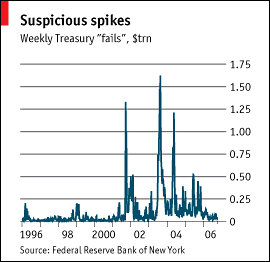
There is an article in the Economist this week discussing issues of concern to the Treasury. These concerns involve lending institutions from around the world which the U.S. is borrowing from. The treasury is concerned about the behavior of the banks we are borrowing from. This is largely due to the fact that banks can manipulate the market by restricting the supply of notes. One of the ways they do this is by "parking it with custodian banks." When there is less supply of the notes, banks can and often due profit by using them as collateral for loans. "They do this in the busy repurchase (repo) market, where treasuries are sold for cash with agreement to buy them back later. The scarcer the security you want to swap, the lower the interest rate you pay for the cash, known as the repo rate. On some issues this year the repo rate has fallen close to zero."
The treasury's concerns stem from the large amount of debt the U.S. currently carries. Increases in borrowing costs have more significant effects than ever before as a result. "Overnight money now costs 5.25% after 17 straight hikes." It is costing more and more to borrow which some banks believe it is justified in light of the 'risk' they are taking. Some however view this as “an exercise in monopoly pricing”. If a lendininstitutionon raises its interest rates, it is safe to assume many others have also taken that step or are taking that step at the same time; otherwise the lendininstitutionon would loose its customers.
The Treasury is very concerned with these movements because as mentioned before, "the market for its debt is the world's deepest and most liquid, with an average daily volume of $600 billion—many times more than America's share markets." Therefore behavior of banks is of enormous importance to the treasury, perhaps more than any other country in the world. It is also important to note that because the Fed implements monetary policy- it is expected to provide a "risk-free benchmark against which other credit is measured. If it is not squeaky clean, investors could turn tail, raising the country's borrowing costs."
Some argue that manipulating the market would be difficult because of its enormous size; consequently even a few adjustments should not have that big of an impact. Despite this the Treasury is still worried. Another concern is the "sharp increase in treasury settlement “fails” in the past few years, caused by a failure to return securities on time to the lender: these tend to jump when the repo rate is low and bonds are scarce."
There is also a concern of "history repeating itself" which is in "reference to the scandal at Salomon Brothers in the early 1990s, in which the investment bank was caught dodging rules on treasury auctions in order to gain control over certain issues". As a result, a joint surveillance program was introduced which says the Treasury, the FED and the SEC get together to "compare notes on the market". The Economist suggests that it's time for them to get tougher. It cites the recent downfall of profits for UBS which was caused by mistakes they made. "UBS which must now try to ensure that any bad smells at its bond-trading desk do not pollute other businesses, particularly its prized wealth-management arm. The bank delivered more bad news on October 31st, announcing a 21% drop in third-quarter profits. The cause was largely put down to poor trading: the bank admitted to, among other things, having been 'incorrectly positioned' in the treasury market." It is believed that if the Treasury, the FED and the SEC get tougher, there would be less suspicious increases in interest rates and problems like what UBS experienced would not occur because lending instituions would be more responsible.
Blue-Green Alliance
This past summer the United Steelworkers Union (USW) joined forces with the Sierra Club to try and use their combined power to persuade the government of the United States to raise wages and improve environmental conditions in the work place. They want coersion to be used from all levels of government. Together the groups have 1.6 million members. Their key issues are global warming, clean energy, fair trade, and reducing toxins. It is said that the Sierra Club can demand higher wages and that the USW can use dues from the members to lobby etc. Ultimately if the two combine their power they will have a good chance of getting what they want. Apparently both groups highly oppose free trade. Unions do not like the market competition that free trade would bring. They want government intervention. The environmentalists are concerned with what "economic development" would do to underdeveloped countries. As the author Ryan Ellis points out in his article "under-developed societies are usually environmental disaster areas. Improvements in air and water quality require the increased wealth that free trade generates." Unions are trying to get the government to transfer more of the "cleanup" funds from their hands to the Unions. Of course it's easy to see why they would join with the Sierra Club! Things like this just make me wonder if these organizations are really concerned with cleaning up the environment and getting people justified wages....or if they really just want money and power.
Friday, November 03, 2006
Social Security and Medicare Problems
Last month the Federal Accounting Standards Advisory Board has proposed to the government that they would have to account for the cost of future Social Security payments each year as people build up entitlements. The FASAB has asked that the United States government to start including future Medicare and Social Security liabilities in current budget deficit figures. Of course the reported deficit would go up by hundreds of billions of dollars a year.
However, under rational expectations this nominal change should be neutral. Looking more abstractly though, more simplicity in government is desirable. Over the long run, government would treat these promises of future benefits more like expenditures. Also, if these benefits are counted in the current budget as liabilities, it’s going to be harder politically to cut them out in the future. One easy way of cutting them out would be to tax them, which wouldn’t be hard to do. If one is in favor of tax hike, they would favor this proposal; however, if one would prefer spending cuts, they probably would not.
Social Security and other related items are big issues in our society today. I agree with those who think that these items are not only liabilities for the future but also promises, whether they will be kept or not. I understand of course why some people are opposed to this idea because of the potential raise in taxes, I don’t want my taxes increased as well. However, I think a possible solution to this is for the government to come up with a plan for Social Security and Medicare is to collect funds without having to raise taxes all the time. The government could figure out a way for there to be a set price and have the money go straight to Social Security or Medicare. I suppose some would oppose this idea though because it almost acts like a contract, since money will have to be “dished” out from now on to these issues. They should not be done away with though, so many people depend on them, the government just needs to come up with better ideas to raise money for them without always raising the taxes.
Subscribe to:
Posts (Atom)