As I look at the last 2 years of the so-called US recovery, I see no recovery. The politicians continue to manipulate the static economic model, the federal reserve (a cartel) is more concerned with keeping their elite associates in business (banks, wall street, autos) with 0% loans, and supporting an absurd monetary policy by monitizing the US debt. I would have thought this turmoil would have initiated change in the way US citizens purchase the 2 biggest items in their lives, homes and automobiles.
The majority of US citizens have begun to figure out how this capital consuming policy works for those 2 large purchases. Why could'nt the US government have taken the existing commission structure for purchasing a home from 10% of the purchase price, divided between numerous middlemen, to 5%, instead of a short term home buyer tax credit policy? Why did the auto industry recieve taxpayer bailouts, and the cash for clunkers, a short term fix? Sorry car salesmen your capital consuming model needs to change also.
The unfortunate relationship between the US government, the large banks, wall street and the auto industry has to change, in order for the US economy to recover. Printing money, spending to create a larger government and thinking time will cure the pain is absurd. It is only prolonging the inevitable. If failure would have come to the corporations that caused this debacle, the system would have been cleansed, and new blood and new ideas would have emerged, like the ones discussed. While the corrupt individuals would have been fined, terminated and sent to jail. Also, the federal reserve should also be dissolved. Instead they are continuing to consume our capital.
Olsen was correct in his theory of how smaller groups with power are harder to dissolve, especially those connected to the large powerful and growing government. We can only hope for a crash sooner than later, this will detach the 50 year relationship with the government and the elites, and their capital consuming policy. Oddly enough as I write this contribution, the makets have closed on a rediculous high for the month of September, the biggest rally for the month of September in 70 years. This closes out the third quarter on a high, the monthly high, and the weekly high. If the equity markets do not make a new high next week, look out below. Buy some puts, or sell with both hands!
Thursday, September 30, 2010


Kaiser Employees Decide Whether Between Being Represented by Large Union or Small
Kaiser employees in California have been given a choice on whether to stay with SEIU, (Service Employees International Union) or to switch to a group formed last year named the National Union of Healthcare Workers. Kaiser is asking union member employees at over 300 facilities in the state to make a decision. After reading the Logic of Collective Action one would believe not many members would vote. Olson’s logic concluded that the personal incentives for voting would be small so participation would be limited. In fact Olson chose to include a quote on page 86 that read, “ Over 90% will choose not to attend a meeting or participate in union affairs; yet over 90% will vote to force themselves to belong to the union and make considerable dues payments to it.” But in fact just fewer than 50,000 union members showed up to vote on the matter, making it one of the largest union related votes in California history. So many people wanted to participate in the matter because they felt this smaller company could do a better job representing them.
SEIU is a very large union group representing about 1.8 million workers in the U.S. They have been around since 1921 and a lot of people stick with them because they have been successful for a long time. The statement NUHW is expressing to the Kaiser employees is that they are a smaller organization and are going to help represent the employees on getting better health care and pay raises. This is a good example on Olson’s theories behind the sizes of groups. Olson wrote that if a group gets too large it could prove to be deadly for the organization. This younger union is saying they have less people to represent therefore they can represent each individual of the Kaiser company better than SEIU can. If the employees in California vote for NUHW to represent them it would support Olson’s theory on group sizes.
Sources:
Carlson, Ken. "Kaiser workers must pick a union." Modbee (2010): n. pag. Web. 30 Sep 2010. .
Wally World is taking over!!
It’s true, Walmart is going to take over the world one day, and it’s pretty much inevitable at this point. Walmart is also very anti-union. Who can blame them? Unions were bad to being with, but then you read even more about it from Olson and you begin to wonder why they even exist. We’ve all heard various horror stories about unions, the union giving the air traffic controllers the air traffic control center over in Pittsburg, forcing ridiculously high wages across the country, promoting violence, and not doing the things they say they will. Props to Walmart for avoiding that one!
Oh wait, so about Walmart taking over the world… They’re moving to South Africa now, and the South Africans are not happy about the anti-union nature of Walmart. So that they could proceed with their plan to take over the world, Walmart caved to the South Africans. It is such a sad day when such a great force caves to such evil. These unions don’t play around either, they get 7.5% wage increases, and 12 cent raises.
The South Africans claim that these unions are necessary, whereas the ones in America are not. And that their unions won’t allow Walmart to ‘exploit’ their workers as they do in other places. The South Africans are being assured that Walmart has complied with all the labor laws wherever they operate, and will abide by them in South Africa as well. However they do have the intention of wiping out all competitors in the market there.
As mentioned Walmart (whether you like it or not) is a great force, and because of that they have a certain ability to get away with things. I don’t know what the labor laws are in South Africa, (from the sounds of it, they require unions in all industries) but I will also be interested to see how Walmart feels about these unions. In reality, I’ll be interested to see where Walmart draws the line and says enough is enough because you know Walmart isn’t going to be handing out 7.5% wage increases. There are already people in South Africa saying the laws are out-of-date, although more so people are angry about Walmart’s dislike of unions. It shall be interesting to see how Olson’s Logic of Collective Action will apply in this scenario. Stay tuned for more!
Tuesday, September 28, 2010
Marijuana Begins to Unionize
Browsing through an edition of the Wall Street Journal from about a week ago, I discovered an article titled "Teamsters Organize Medical Marijuana Growers." Stu Woo, the author of the article, spoke on what he perceives to be the "first pot growers to unionize in the country," stating that around "40 employees of an Oakland, Calif., marijuana-growing company joined the Teamsters union earlier this month" (Woo A8).
I was quite surprised with this news, learning after a bit of browsing that this unionization had been progressively under way since May of this year (AOL online). Thanks to the ratification of a two-year contract, it appears that the workers will not only see a wage increase within the next year and a half, but they will begin to receive health-care and pension benefits as well. And as for the employers? They supposedly love it, citing that this will help solidify and protect their workforce.
Now, while there are varying opinions concerning the ethics/ economics/ politics/ (insert debatable topic here) with regards to marijuana and the legalization of such, it is becoming more and more difficult to ignore not only those who argue over their personal freedoms and rights to choice, but additionally, with this unionization of the workers who are beginning to make a livelihood from the cultivation of what is still quite illegal under federal law, one has to ponder a number of questions. Will this unionization last, or is this a situation where Olson's theory will inevitably prove correct once again? If so, how will it affect neighboring cities/ counties/ states? What implications or influence will this newly-formed alliance have on not only the future of the employer-employee relationship within this industry, but also regarding sentiments and opinions across the country? And finally, what kind of impact will this have on federal law? Even Coloradans can relate to what seems to be a changing of the times since we now live amongst dispensaries ourselves.
I was intrigued by this article, particularly since we are hot off the heels of Olson's dissertation examining the vitality, lifespan, and influence of similar large groups. My lack of knowledge regarding any selective incentives leads me to skepticism in terms of this group's survivability, but just because I couldn't find anything, it doesn't necessarily mean that there are none whatsoever.
This could be the start of a trend, but I guess we'll have to wait and see just how many growers actually choose to unionize, especially if it eventually spans the country (as well as how many growers choose to simply 'free ride').
Sources:
Woo, Stu, "Teamsters Organize Medical Marijuana Growers," Wall Street Journal, September
22, 2010, A8.
"Calif. Medical Marijuana Workers Vote to Join Union," last modified June 6, 2010.
http://www.aolnews.com/nation/article/california-medical-marijuana-workers-vote-to-join-union/19496681
Unions vs Peter Jackon
Peter Jackson wants to film the two-part Hobbit movie series in New Zealand. The original Lord of the Rings trilogy was filmed in New Zealand and he wants to continue filming there because it adds a lot to the movie with the big environments. Peter Jackson is employing thousands of workers to make these movies. The studios are ready to start filming but there is one problem... There are no actors to film. Peter Jackson wants to film this movie with non union actors. Jackon will not meet with unions to discuss deals. Jackson states:
"I feel growing anger at the way this tiny minority is endangering a project that thousands of people have worked on over the past two years, and the thousands about to [be] employed over the next four years, [and] the hundreds of millions of dollars that is about to be spent in our economy."
The unions are saying that there actors are "advised not to accept work on this non-union production." We will see if the film is even made at this point. Jackson may move the production up to Austria where many other movies are made if there is no fix to this situation.
This all comes down to the unions stopping their actors from making money by doing their jobs. I thought that the unions were supposed to help the workers not hurt them. Who knows what Peter Jackson and the sudios are willing to pay the actors, I'm sure its plenty of money.
Jackson said, "There is a twisted logic to seeing NZ [New Zealand] humiliated on the world stage, by losing 'The Hobbit' to Eastern Europe."
Incentives
The fundamental axiom of Mancur Olson’s The Logic of Collective Action is that people act with a purpose. People will act when it is in their self-interest to become involved. Large groups that do not hold power through the application of government force have found that they can gain members by offering selective incentives. People respond to all sorts of incentives: both positive and negative. The government like any other large group can create incentives to motivate people to act. For example, I abide by the speed limit to avoid the price of being caught and fined. However, incorrect incentives can have unintended consequences.
BP and the Federal government are currently discussing to what extent BP should be held liable for its role in the recent oil spill. The debate is over whether BP should be considered negligent or not. It is in BP’s interest to avoid being considered grossly negligent because under the Clean Water Act alone the difference between a mistake and gross negligence is over 15 billion dollars. The various levels of government would like to see BP pay the higher fine in order dilute the cost of the clean up the government will have to bear. If BP and the involved members of government cannot reach a compromise the case will go to court. The main incentives on the two sides are at odds, but the government has an additional incentive: If the matter can be decided outside of court the repairs can be started sooner which would please constituents. Whether or not a decision is reached quickly will depend on how the government leaders involved value the two incentives. As Olson points out the minor players in any organization, in this case local government officials, have little actual power because those with the most to gain, the involved members of the Federal government, will look to their own interests first.
But can the government truly say that BP was negligent? After all if it seems that BP was negligent it is surely because the government provided incentives that led BP to act as it did. The limited liability policy BP was drilling under in the gulf meant that BP knew it would not be held accountable for the entire cost of any spill. It is therefore in the managers of BP’s interest to provide spill protection until the marginal cost of spill protection is equal to the marginal benefit. It would have been negligent of BP to spend less than where marginal cost equals marginal benefit, but the government has no certain way of determining whether or not BP did this. By creating a limited liability policy the government reduced the costs of an oil spill to BP and therefore made it more likely that BP would do less to prevent one. The government has brought the current dilemma on itself through its own policy decisions. The members of the government failed to recognize the consequences of the incentives they were offering. In a similar manner an organization without force that offers unappealing selective incentives will not survive, because people will not join the group solely for a collective benefit.
Reference:
“BP, Feds Talk Over Spill Fines.” The Washington Times. 28 September 2010.
Wednesday, September 22, 2010
Social Security
On page 171 in the appendix Olson states, “But even a project that involves more gain than cost will leave more losers than gainers, if the gains go to a minority of those in the jurisdiction and the cost is covered through jurisdiction-wide taxes. When a collective good reaches only a minority of those in a jurisdiction, then, it will not get majority support, and will be provided, if at all, only to a less than optimal degree.” The first thing that came to my mind when reading this was Social Security taxes. Social Security is a nation-wide tax that we must pay for someone else’s benefit.
We pay these taxes out of every paycheck which then immediately go to the minority who receives it. Why must young people continue to pay Social Security to benefit this minority? After all, when young people retire, there will be no Social Security for us and there will be no one paying taxes for our benefit. We will be the minority in the future, but yet will be receiving no similar benefit for which we pay for the current minority. There will be nothing left in Social Security! What about the future and retirement of young people? Why not let younger workers contribute to their own Social Security which will allow us to invest our own funds for retirement?
Even if government raises Social Security taxes to support the current benefits of the minority, it will still be broke by the time we should be receiving the benefits. Why should we support and benefit the current recipients if no one is going to support us (especially with higher tax rates)? This benefit is provided to a less than optimal degree as Olson suggests. Social Security costs more than the taxes collected. As we move forward, the retirement age will be increased, as well as the tax rate with a higher cap of annual wages, or even no cap on wages at all. Even as this happens, the amount of Social Security benefits will decrease to each recipient, and may not even reach the total amount of retirees.
We should be allowed to put our own Social Security taxes into our personal investments and accounts for our own retirement – not someone else’s retirement. Why are we relying on the government and expecting government to provide us all retirement benefits? We all know that the young workforce will never see the benefits we paid so much for!
Here are some poll results:
• More than 88 percent of Americans believe that Social Security either is in trouble today or will be in trouble within the next 20 years. Fully 60 percent of all Americans under age 65 believe Social Security will not be there for them when they retire.
• As a result, more than two-thirds (69 percent) believe that Social Security will require "major" or "radical" change within the next 20 years. Among younger voters, approximately half believe that major or radical change is needed today. The support for change cuts across ideological and party lines.
• Voters reject most traditional Social Security reforms such as raising the retirement age, raising payroll taxes, or reducing benefits.
• Approximately two-thirds of voters would support privatization of Social Security, transforming the program into a privatized mandatory savings program. More than three-quarters of younger voters support privatization.
Saturday, September 18, 2010
People Act with a Purpose
People act with a purpose. When Dr. Eubanks mentioned this idea on Thursday, it resounded with me. This axiom on which Mancur Olson basis his theory in The Logic of Collective Action does a great deal in providing an explanation for any and every human behavior. No matter who the person is or what he decides to do, he exists for a purpose, and he decides for a reason. Every individual who acts and every group that is mobilized (whether large or small) follows this principle. Furthermore, since people are purpose-driven, incentives matter. This comes as no surprise of course. People do what helps them further their purpose and goals, and incentives can be critical in determining whether an action will further a goal or not.
In general, why do people fail to contribute to a group? Naturally, it is because they are not incentivized to do so. In The Logic of Collective Action, this is what Olson shares with us. People only contribute to a large latent group if they are forced to do so or if they receive some personal benefit or incentive for doing so. More specifically, I would like to ask this question: why do people fail to contribute to this class? Well, our class is not a large latent group. Really, it is a small group—only about twenty people. I must admit I am surprised by how few people actually speak up in class. However, perhaps I should not be so surprised. The students in this and in any class are each here for a different reason. We each have our own purpose for being present. What are the incentives for class participation? One would certainly be a better grade, another would be the personal satisfaction that comes with participation, and a third would be an increased understanding of economics and of the world in general. Of course, there are also always trade-offs, and each student has a different opportunity cost for participating in this class. Each student must make a decision. If the marginal benefits of class participation and of the adjoining incentives outweigh the marginal cost of such participation, the student will participate, and if not, he will choose not to. Dr. Eubanks will not force us to participate in his class. He will only incentivize us to do so. Each individual values those incentives differently and also faces a different opportunity cost. Therefore, some will participate and others will not.
People are reasoning individuals who care about something (whether that be learning, making money, getting a degree with as little effort as possible, spending time with friends and family, etc.). We wonder why others do what they do, and though the reasons may be obscure to us, each person is acting for some purpose. There is an underlying reason behind every action—both individual actions and collective ones.
Monday, September 13, 2010
Logic and the NFL
Yes the title is correct, the logic of collective action and the National Football League. How do those two belong in the same sentence together? Well let me tell you. I love the NFL(and yes the Bengals are going to win the Super Bowl this year like every year right until they go 3-13), and sometimes its easy to lose sight that the players on the field aren't just football players but they are highly paid employees of the NFL. As workers they have interests to protect just like coal miners or any other workers do. Interestingly enough, the theories discussed in Logic are very relevant to the NFL.
Logic discusses the origins of unions and how they emerged originally as small groups that fought for the rights of their workers. As seen in the article posted above, the NFLPA (NFL players association, a union) started as a group interested in securing basic rights for the players such as sufficient per diem money for food and so on. As the popularity and revenue that the NFL brought in increased over time, the NFLPA became a much more powerful and well known union.
The NFLPA provides its players many selective incentives to be a part of the union. Although I have not found in my research whether membership is compulsory, there are many reasons why the players would want to be a part of this union. The NFLPA has fought for minimum wages for their players and health benefits for retired players just to name a few. I have not found any reports in my research saying that there are players in the NFL not in the NFLPA, which would lead me to conclude that while it may not be compulsory to join the union, every player in the NFL is part of the union. Without the security that the NFLPA provides to the players through benefits, minimum wage, and free agency rights, players would be vulnerable to be exploited by the NFL owners and the league. So in summary, the NFLPA is held together by the selective incentives that it offers to its members.
Another topic of interest from this article is the NFLPA strikes. During the first strike the season had to be cancelled because nobody wanted to play until they had a collective bargaining deal in place, which is not too exciting in our discussion of Logic, but the second strike brings me to a bigger point. In the 1987 strike, many star players including Joe Montana crossed the picket lines and starting playing football. In Logic, Olson states that there is a very strong incentive for workers to cross the picket lines and work because it gives them a good source of income that they would not be receiving otherwise. To my knowledge, the NFLPA did not have a real forceful way to keep their players from playing, so this fits right in with Olsen's theory. Whether it was the income and benefits or the pure joy of playing football that caused players to cross the picket lines, without a real force to keep players from playing the NFLPA strike buckled because they couldn't keep enough of their players off the field and participating in the strike. Apparently the goals that the union were trying to accomplish were not enough to keep the players from striking.
If you haven't been paying attention to ESPN lately, the current collective bargaining agreement ran out this past year and there is a potential work stoppage looming next year. The NFLPA is trying to increase the percentage of NFL revenue given to the player salaries, which has the NFL owners and commissioner scrambling to come to an agreement with the union. It is yet to be seen whether the players will execute a strike for higher wages or if the individual incentive to keep playing football will force the union to buckle yet again. I guess we'll find out next year.
Sunday, September 12, 2010
Logic and the American Revolution
On Thursday, Dr. Eubanks posed an intriguing question: “Is the American Revolution consistent with The Logic of Collective Action? What was different about this revolution that allowed it to end in democracy?” To probe our minds, he provided a suggestion: the American Revolution arose for the protection of individual rights, something the British government had discontinued. Dr. Eubanks emphasized the fact that the colonists had previously held these rights and that these rights had been usurped. What does this tell us about the American Revolution? Unlike other groups/unions, the colonies were advocating for lost rights, not for new ones. This differentiates it from other groups. The colonists were able to form a government based on one that they had known rather than creating something out of thin air in response to new desires. In this way, they were able to protect all rights, not simply a list of new ones at the cost of the old. This may partially explain the reason that the United States did not become a dictatorship, but it does not provide a full answer and does not begin to answer the first question (i.e., “Is the American Revolution consistent with The Logic of Collective Action?”).
The democracy also arose because multitudes of people helped to develop it. How did that happen? How did a large group form and act and create a democracy? The Logic of Collective Action suggests either force or selective incentives. Additionally, Olson’s theory states that large groups usually evolve from small ones.
The American Revolution evolved from a confederation of smaller entities which joined forces. However, these entities (i.e., each colony) were not small groups. So what held them together? According to Olson, either force or selective incentives catalyzed them to action. Force did not hold the group together (although the force of the British government may have given them incentive to join the revolt). Therefore, selective incentives must have been the means by which the group was formed. But what were the selective incentives? They would all be better off if they won the revolution; however, this is not a selective incentive to each individual. According to Olson (The Logic of Collective Action, p. 65), rational individuals would not have joined because they would not have seen their impact and would have received the benefit if others had achieved it. In addition, rational individuals would not have joined because the colonies did not have a good chance of winning. Nonetheless, I do believe that selective incentives were involved. Each individual had his own individual incentive. Some of those were a desire to serve, pride, the desire to better the lives of their families and their descendants, perhaps anger and a feeling of personal injustice, and so on.
Perhaps the American Revolution is consistent with The Logic of Collective Action but is not fully explained by it. The logic is consistent but it does not explain the action. In Chapter Six, Olson stipulates that “…like any other theory, [his] is less helpful in some cases than in others” (The Logic of Collective Action 159). He continues to explain that his theory is not as useful for explaining noneconomic groups as it is for explaining economic groups. I would argue that the colonies united in the American Revolution for reasons in addition to economic ones (e.g., political, moral—though certainly not religious—, familial, social, and etcetera). Olson’s theory does not falter under this example because the logic is consistent; but it cannot fully explain the group that initiated the American Revolution and formed a powerful democracy. Like irrational groups, which Olson’s theory is not useful in explaining (p. 161), these individuals saw a greater benefit in action likely to be unsuccessful than they did in latency. In order to understand the success of the American Revolution, we need to utilize other theories, such as psychological and sociological ones that account for action outside of Olson’s definition of “rationality.”
Friday, September 10, 2010
ASHA and Other Professional Associations
In The Logic of Collective Action, Mancur Olson theorizes that any large group must be held together by one of two factors: force or selective incentives. As I have been reading and contemplating his work, I have also been attempting to apply his theory to groups that matter to me. Since I would like to become a speech-language pathologist, one organization (or group) that came to my mind was ASHA. For those of you who do not know, ASHA stands for the American Speech-Language-Hearing Association, which is a national professional association comprised of speech-language pathologists and audiologists. Professional associations are organizations of professionals intended to provide standards of practice and to protect both the public and the organization’s members.
From its roots in 1925 with 25 members, it has grown to include 130,000 members as of 2008. This growth is astounding. Applying Olson’s logic, I wondered what has held the group together and increased its membership. As a rule, membership in ASHA is not compulsory: speech-language pathologists and audiologists are required to be certified but they are not forced to join ASHA and can obtain certification elsewhere. They can be and are employed without membership in the organization. Olson’s theory would predict that the association must therefore be held together by selective incentives.
This does indeed seem to be the case. Researching the ASHA website (www.asha.org), I found that the selective incentives for joining the group are quite strong. Among the benefits highlighted on the ASHA website are “professional publications,” “continuing education opportunities,” “networking opportunities,” and “career-building tools.” Looking further, I noticed a matching site for those seeking speech-language therapy services; this feature would garner independent clients exclusively for ASHA members. Additionally, most professionals (I would hope) seek to serve their clients and advocate for their clients’ needs as best as they can, and this desire is upheld in ASHA’s vision and mission statement: “empowering and supporting speech-language pathologists, audiologists, and speech, language, and hearing scientists by: advocating on behalf of persons with communication and related disorders, advancing communication science, and promoting effective human communication.”
Returning to Olson, the speech-language therapists and audiologists who join ASHA are driven to do so not by force but by the selective incentives such membership provides. Because force is not the driving factor behind membership, not all professionals in this field belong to ASHA. However, since the selective incentives are attractive and powerful, many professionals do opt to join.
Wednesday, September 08, 2010
Healthcare Scare
As a former healthcare finance manager with 15 years of experience in the industry, I'd be remiss if I didn't start this post with the admission that I MAY be a bit biased on this issue. My perspective comes from being an industry insider as well as a student of economics. That being said, as we read The Logic of Collective Action, I can't help but consider the healthcare reform legislation in terms of what we are learning about group behavior as it may apply to the providers of care; doctors and hospitals. Looking at some of the changes through a narrow view finder focused on incentives, I am growing more concerned about the unintended consequences we are bound to see materialize.
Every doctor I have ever worked for had ZERO financial incentive to provide care to Medicare or Medicaid patients. The reason is that Medicare reimburses 73 cents on the dollar and Medicaid 52 cents on the dollar of COST. Every patient a doctor sees with a governmental payer is treated as a loss. Thus as I read Olsen, I find myself wondering why they do. Olsen's ideas on incentives led me to do some research and although the answer is obvious after our readings, before it was not so apparent. The simple answer is force/coercion. In order for a hospital to obtain a business license, they must accept Medicaid, any doctor affiliated with said hospital is also thusly coerced, and private practice doctors cannot be granted privileges to treat patients at hospitals without Medicare and Medicare certifications.
So then, what can we expect as a result of the new rules, regulations, and incentives/disincentives in the new law? Following the process through to its logical conclusion, I see only two possible outcomes; A) a breakdown in the provider function of our heathcare system. Adding millions of people to a system using force to provide care without EQUAL force to create the neccessary providers will result in providers leaving the market and a critical excess of demand will arise. Or B) the providers will elect to leave the insurance market and become cash only ( because as of right now, there is no governmental coercion under contract law to force them to remain), which will also create an excess of demand for services among the people the law was most intended to help, those that cannot afford healthcare to begin with. Either is unacceptable.
Friday, October 31, 2008
Liberalism
As we have dicussed throughout the entire semester, most of us agree that a liberal economy is the best way to go. With all of the interventions that the government makes it drives our economy down and is one of the main reasons that we are in such an economic turmoil right now. Why, if this is so obvious of an answer to most of us in class is it so hard for the politicians and the high ranking government officials to figure out. They should have people that are more educated than us, as undergraduate students. Why don't they see the same things we do. Could it be that we are actually wrong, or is it that with all of the interventions that have already been made that it is already too late to change what we have? Whatever the answers we need to fix this mess we have made and need to have the right people in place to be able to do the things that this country so desperately needs.
Friday, May 16, 2008
Is America Still Racist?
Doggy Discrimination occurs daily. When I read this I laughed not taking it seriously, all dogs are cute right? Well apparently some people prefer a certain color of dog. This is understandable, but color discrimination among dogs? Black dogs are not being adopted in shelters. They seem to be the last ones adopted from almost every kennel in the country. A Kennel in Ohio even posted a banner pleading with people to check out their beautiful black dogs. This is in part due to perceptions people have about black dogs, maybe they are mean, or sometimes are perceived as being old, they are also not as eye catching as other more brightly colored dogs. There are also preferences and biases, and people seem to prefer lighter colored dogs. There biases lead them to believe certain things are untrue about a dog because of the color of its fur. Hmm... sounds vaguely familiar. Unfortunately this results in many lovable dogs left in animal shelters. People’s preferences and self interest at work even when it comes to dogs people are biased.
Student Loans the new Sub Prime Crisis?
Recently while zoning out in front of the T.V. I heard several advertisements for student loans. These ads suggested that students could borrow up to $40,000 per year to cover college expenses. This seemed exorbitant so I researched a little and sure enough websites such as Astrive.com and ThinkStudentLoans.com both offered these amounts. I know some high profile private schools are expensive, but to offer a young adult right out of high school $40,000 a year for school seems ludicrous. Someone could potentially accumulate $160-200,000 dollars of debt before the age of 25. This seems like a recipe for disaster with tons of kids bogged down by enormous debt my guess is a large number will default on the loans. Sometimes I feel overwhelmed with a car loan that will only take me four years to pay off, not the rest of my life.
Granted there are some stipulations different from Sub Prime mortgages. The loans require a credit check and some require a co –signer; however the amount of debt students generally between the ages of 18-25 can incur in a short amount of time seems to indicate a high amount of young adults defaulting on loans because they were unable to grasp the financial situation they put themselves into.
Stephen Colbert Brings to light the sclerosis of America
Stephen Colbert, host of the Colbert Report began a new series in February called Better Know a Lobby, in which he interviews lobbyist and examines their agendas. The humor of the series is that it supposedly consists of 35,000 parts because that is the approximate number of lobbyist in Washington. On Wednesday March 12, Colbert introduced the series by saying “I thought our laws were written by lawmakers, but like the best literature they are often crafted by ghost writers… called Lobbyists” (Colbert). This quote while humorous is also disconcerting. 35,000 people whose sole purpose is to create laws in order to further their own self interest. That is a perfect example of the sclerosis that leads to lowered productivity in an effluent society according to Mancur Olsen.
The Fed messing around with the economy
I used to believe that the Fed was doing more good for the economy than doing it harm. I'm starting to question these thoughts now. How is the the Fed's impact on the economy by changing the money supply and interest rate going to help? It's natural to have times of economic growth and have times of economic recession. That is just all part of the economic cycle. Now the argument has been made that the Fed minimizes the volitility of this cycle to prevent an extreme recession.
Now this is a worth-while goal but can it really be accomplished? When the Fed keeps printing money and lowering the interest rate I just see more problems for us in the future. Many are starting to surface now. I agree with those who would say that money is a commodity and needs to be protected. If the Fed just keeps printing money for all the spending the U.S. does there will be negative consequences in the future. The consequences we are facing now were long coming.
The Fed is unconstitutional and I have even heard some conspiracy theories about the beginning of the Fed. There was never intended to be a power like the Fed in our country. I'm afraid that we will suffer some of the consequences for what the Fed had done in the past. The recession that we have had building up for a while could be coming.
Private Property
Private Property rights are pretty much the best thing since sliced bread...ok, they probably came before sliced bread. Private property creates stability in a society. When someone own's something they are going to take good care of it. It is in their self-interest to take good care of their own possessions. Private property also aids in law enforcement. With private property there is an incentive for the owner to protect his or her possessions from theft.
So these are all things that most economists know and all things that are mentioned in Power and Prosperity by Mancur Olson. The scary thing that some people don't realize is the connection between taxes and private property. Now, before going further let's explain what a tax is. At a bare minimum a tax is a portion of societies money that it used to pay the government to enforce private property, enforce contracts, and in today's day and age to provide a country with national defense. I believe that this type of tax is good. However, when a government taxes beyond these boundries the tax becomes a redistribution of wealth.
This redistribution of wealth acts is the government infringing on private property instead of enforcing it. Our possessions are our private property. When the government takes from some people in the form of a tax to give to others where is the enforcement of private property.
Now we are overtaxed in America but I can live with that. This doesn't mean that I won't stand up for the economic freedom I believe is rightfully ours as outlines in the constitution but we are taxed much less that other countries. In some countries taxing takes away much more production than it does in America.
However, here is the scary thing. The government in America sometimes uses taxes to take over private property. Sometimes taxes are intentionally raised so high that people can no longer afford to live there. I have some friends that own some really nice property up in the mountains of Colorado. They have lobbying pressures from developers that want to mine the surrounding area including their property and they have lobbying pressures from environmentalists that want to make the area accessible by hiking only. As a result taxes are beginning to sky rocket. If this continues they won't be able to own the property for too much longer...and they are even pretty well off.
It is ironic how our governement infringes on private property sometimes when it has the duty to protect it...probably more scary than ironic though.
Thursday, May 15, 2008
Myanmar Crisis
Since I've been following the recent crises in Myanmar I thought I would check out the Economic situation of the country and share what I learn with you all. I went to CIA World Factbook at this link: https://webmail.uccs.edu/SRedirect/www.cia.gov/library/publications/the-world-factbook/geos/bm.html to get a quick overview of the country. The country obviously includes most of the symptoms for a bad economic situation.
The country for all intensive purposes has been under military rule since 1962. Today there is much unrest and instability in the country. The junta refused to give up leadership of the country to the rightfully elected president in 2003. There are are other major corruption issues in the country as well. It is a big source country for human trafficking and there is bound to be other major humanitarian issues in the country.
The country has been devestated by the cyclone and the situation is just getting worse. The latest state media report raised the death toll to 43,318, with nearly 28,000 still missing and another two million in dire need of help. Red Cross says there is a good chance that 128,000 people could be dead already. We'll probably never know the real numbers. Even the number of people who died in hurricane Katrina in the US was vastly under-reported. I learned this by talking to people who were there when the storm hit. But what we do know is that the situation is bad.
There are many ideas from Mancur Olsen's writings that can be applied to this situation. The main story obviously is corruption's negative impact on the country which is discussed in power and prosperity. International aid is not being allowed into the country. Why would the junta government refuse aid to its people? There must be big issues, probably humanitarian, in the country that the government is hiding. I'm suprised that the junta isn't letting aid in just for the sake of its perception in the eyes of the people.
It could be that a revolution rises up because of this situation. This is a catastrophic event that could completely change the country around. It could be that good comes out of this tragic situation if you follow the reasoning from the Rise and Decline of Nations. We will wait and see what unfolds.
Police Power
A theory of power within society allows one to examine the mundane coercive forces of life with a clear mind free of emotional attachment. It is my hope to expound on such a theory. I start, ironically, with an observation.
I found myself in a parking lot at approximately 11:00 pm. The parking lot was empty except for my friend's car beside my own and a hidden police car. The police car remained hidden until I was saying my goodbyes to my friend. The police stopped me and my friend. After that scripted interrogation the policeman concluded that I was a criminal because I had alcohol within my car and I was not yet the age the state had considered that to be acceptable. The police officer then gave me a tacit ultimatum, he would either act upon my criminality or I would give him permission to search my car. The stakeout and subsequent ultimatum imply a forward thinking tactic designed to entrap a greater (or lesser if you care for irony) criminal. This is by no means a fluke, it is not even the most striking example within my experience. However, this event lead me to ponder the reasons of the criminalization of everyone.
It is unimaginable to find someone who has not violated at least one traffic law. Such edicts create a society where everyone is a criminal. Is this a coincidence? A waste product of a vast bureaucratic bumbling? Or a deliberate process on the part of a minority group within the state? I will answer these questions in the second part of this writing. It is important to understand by conscious action or not, the American system of government has created a system in which every person commits a crime in the process of living. If we have abundance of criminals we will have an abundance of their antitheses, the police.
The police are the sacred cows of American society. Linguistically, the police are raised above the average man with designations like “officer.” More importantly, police forces are also above the same laws that brand most men as criminals. For example, the policeman going above the speed limit is “doing his duty.” In such a manner the police are the only “clean” or “pure” class of citizens. If many crimes are crimes by fiat and not by the aggression upon property, it would also hold true that police are not criminals by fiat. It is a decree that that allows police to function in the super-legal fashion. This unequal application of the law creates a privileged class of individuals.
The privileged legal position is police power. In my example it was the leveraging of this power that allowed the policeman to issue the ultimatum.
The further criminalization of everyday life expands the gulf of power between the police and the common man. The gulf is represented in my example by the ultimatum. An expansion of police powers might mean I could be facing a prison sentence instead of a fine or court date, thereby raising the opportunity cost of resistance. Put simply, if the opportunity cost of resistance increases, the amount of resistance from a society will decrease. As the opportunity cost of resistance increases there is another important shift; the opportunity cost of coercion decreases. The lower amount of resistance will be met with a higher rate of coercion. A coerced transaction is unproductive. Unlike a voluntary transaction, the forceful nature of an involuntary transaction means that one party is losing. However, the other side of this truism is often ignored; one party is benefiting. In my example, it is possible the ultimatum was issued in the hope of finding drugs or cash that could be used personally by the policeman or maybe a satiation of the puerile detective thrill. From the perspective of a legislature the benefits of such transactions is the lower opportunity cost of further coercion.
The criminalization of everyday life creates a privileged caste within society, the police. The extent of this disparity in law is the gauge of police power. The exercise of police coercion lowers the opportunity cost of further coercion in “street” transactions and, on a larger scale, legislative coercion. The decrease in opportunity cost will lead to an increase in aggressive actions of individuals. And an increase in aggressive action is why “____ the police” isn't just an NWA verse.
by Alex Devore
Efficiency and Defense
How can be defense be privatized? I cannot answer that more than I can answer how watches and delicious miniature pickles could be provided for privately.
Usually the question is asked by people with a modicum of economic understanding or sometimes by people with much greater insight. It's these people and not the women and effeminate males goaded into outbursts of "WELL WHAT ABOUT" with the necessary follow up of "environment, homeless, community" and any other sundry non-existent plebeian prattle who attend the same social functions as me. I descend further into a stupor of belligerency and the only substance that makes other people tolerable. As the crowd gathers, a clever and observant bystander might see me slurring my words and unleash four years of state education, blurting out "WELL WHAT ABOUT DEFENSE", which is unfortunate for us both because I suddenly break out into a fit of laughter as I imagine Daniel Day-Lewis shouting,
"draiiiiiiiinnnaaageeeee".
But going back to people that matter a little bit more, these are the people that understand defense in an efficiency framework. In other words, they would understand that defense must be provided for by an external third party because of "free riders" or external beneficiaries. Because there exists a group of people that do not pay for the service of defense yet gain from it. The optimal amount (that's where your lines cross or your equal sign is happy)is now achieved. In this case, the economist would say there is not enough defense provided. Ergo, the super humans that comprise what we call government will intervene. This is commonly called taxation. Productive people have money taken from them and that money, without a doubt, goes to pay for defensive things like spreading democracy.
Actually, that's how I imagine almost every paid economist's day occurs. They slide open their drawer and pull out their TI-89E (Economist's Edition). Their eyes glaze over as they take off the plastic casing reveling Ben Bernanke's autograph on the back panel. Then they plug in a couple numbers, make their equal signs happy with a couple assumptions or a larger margin of error and call it a day.
"draiiiiiiiiiiinnnaaageeeee"
Now that we understand how real world economics work we can proceed.
The problem comes in the "ergo" (that's a fancy word for therefore). It is true, defense of a nation will benefit people who do not pay for it. If I live on the southern boarder and pay to defend it with a wall, then the person living directly north of me might benefit without paying for it. The problem is the common argument leaps from saying external benefit to intervention. It does this because underneath the sleek exterior of contemporary economics lies a monster of JJ Abrams' proportions; also equally as corny. It is the assumption of pareto efficiency. To put it simply, pareto efficiency is the movement of resources to make someone happier without making anyone sadder. Thats right, the nation that brought us parmigiano reggiano, prosciutto di Parma, and Monica Bellucci also spawned Mr. Pareto. Its why we in economics draw the belly button where the two lines intersect.
"Hey look Pa, my economy is pareto optimal"
So using our fancy new words let's rephrase the argument. Privately provided defense will not be pareto optimal because of externalities. Therefore, to achieve
pareto optimality, government intervention is required. The problem is that this argument assumes a framework of both parties. When discussing with economists
subjects like defense it becomes difficult when they don't have the same normative judgments. I don't want pareto optimality. I would rather be pareto un-optimal
and remain untaxed. Now the clever TI-89E wielding economist would retort, "but without defense you couldn't have your utopian free-love libertarding society." This thinking represents the most common flaw in economics, the failure to see the unseen costs.
It is likely that within a system of private defense you would not see billion dollar stealth bombers or giant bases occupied by 19-21 year olds with bad taste
in music. Is this a bad thing? The unseen cost is how much better would my life be if the money that was stolen from me to support this system was instead used
to expand my collection of pretentious German expressionist film? Although this doesn't fully answer the retort. It cannot be answered in any quantifiable sense because it requires us to know things that will never be. For example, for the last one hundred years government was the sole producer of cars, and I come before you and make the claim, "government should stop producing cars". After the gasp of horror has subsided and you ask if I am serious and I nod my head to suggest
I am actually, the retort might be something similar to the one of defense. We very well might not have the tools of what is considered modern war but that is irrelevant because it assumes that what exists now is the best possibility. Going back to the car analogy, it would be similar to expounding on the beauty and performance of a Zaporozhet because it is the only thing that can be seen, ignoring that something like a Maserati would emerge.
The fundamental problem with thinking that defense could not be privately provided is to ignore another possibility. It is failure to understand the opportunity
cost of government intervention. What would emerge if government was to stop providing defense? I cannot say for sure. What I do know is that a system would emerge and in years' past has emerged.
by Alex Devore
Usually the question is asked by people with a modicum of economic understanding or sometimes by people with much greater insight. It's these people and not the women and effeminate males goaded into outbursts of "WELL WHAT ABOUT" with the necessary follow up of "environment, homeless, community" and any other sundry non-existent plebeian prattle who attend the same social functions as me. I descend further into a stupor of belligerency and the only substance that makes other people tolerable. As the crowd gathers, a clever and observant bystander might see me slurring my words and unleash four years of state education, blurting out "WELL WHAT ABOUT DEFENSE", which is unfortunate for us both because I suddenly break out into a fit of laughter as I imagine Daniel Day-Lewis shouting,
"draiiiiiiiinnnaaageeeee".
But going back to people that matter a little bit more, these are the people that understand defense in an efficiency framework. In other words, they would understand that defense must be provided for by an external third party because of "free riders" or external beneficiaries. Because there exists a group of people that do not pay for the service of defense yet gain from it. The optimal amount (that's where your lines cross or your equal sign is happy)is now achieved. In this case, the economist would say there is not enough defense provided. Ergo, the super humans that comprise what we call government will intervene. This is commonly called taxation. Productive people have money taken from them and that money, without a doubt, goes to pay for defensive things like spreading democracy.
Actually, that's how I imagine almost every paid economist's day occurs. They slide open their drawer and pull out their TI-89E (Economist's Edition). Their eyes glaze over as they take off the plastic casing reveling Ben Bernanke's autograph on the back panel. Then they plug in a couple numbers, make their equal signs happy with a couple assumptions or a larger margin of error and call it a day.
"draiiiiiiiiiiinnnaaageeeee"
Now that we understand how real world economics work we can proceed.
The problem comes in the "ergo" (that's a fancy word for therefore). It is true, defense of a nation will benefit people who do not pay for it. If I live on the southern boarder and pay to defend it with a wall, then the person living directly north of me might benefit without paying for it. The problem is the common argument leaps from saying external benefit to intervention. It does this because underneath the sleek exterior of contemporary economics lies a monster of JJ Abrams' proportions; also equally as corny. It is the assumption of pareto efficiency. To put it simply, pareto efficiency is the movement of resources to make someone happier without making anyone sadder. Thats right, the nation that brought us parmigiano reggiano, prosciutto di Parma, and Monica Bellucci also spawned Mr. Pareto. Its why we in economics draw the belly button where the two lines intersect.
"Hey look Pa, my economy is pareto optimal"
So using our fancy new words let's rephrase the argument. Privately provided defense will not be pareto optimal because of externalities. Therefore, to achieve
pareto optimality, government intervention is required. The problem is that this argument assumes a framework of both parties. When discussing with economists
subjects like defense it becomes difficult when they don't have the same normative judgments. I don't want pareto optimality. I would rather be pareto un-optimal
and remain untaxed. Now the clever TI-89E wielding economist would retort, "but without defense you couldn't have your utopian free-love libertarding society." This thinking represents the most common flaw in economics, the failure to see the unseen costs.
It is likely that within a system of private defense you would not see billion dollar stealth bombers or giant bases occupied by 19-21 year olds with bad taste
in music. Is this a bad thing? The unseen cost is how much better would my life be if the money that was stolen from me to support this system was instead used
to expand my collection of pretentious German expressionist film? Although this doesn't fully answer the retort. It cannot be answered in any quantifiable sense because it requires us to know things that will never be. For example, for the last one hundred years government was the sole producer of cars, and I come before you and make the claim, "government should stop producing cars". After the gasp of horror has subsided and you ask if I am serious and I nod my head to suggest
I am actually, the retort might be something similar to the one of defense. We very well might not have the tools of what is considered modern war but that is irrelevant because it assumes that what exists now is the best possibility. Going back to the car analogy, it would be similar to expounding on the beauty and performance of a Zaporozhet because it is the only thing that can be seen, ignoring that something like a Maserati would emerge.
The fundamental problem with thinking that defense could not be privately provided is to ignore another possibility. It is failure to understand the opportunity
cost of government intervention. What would emerge if government was to stop providing defense? I cannot say for sure. What I do know is that a system would emerge and in years' past has emerged.
"It is more a subject of joy that we have so few of the desperate characters which compose modern regular armies. But it proves more forcibly the necessity of obliging every citizen to be a soldier; this was the case with the Greeks and Romans, and must be that of every free State. Where there is no oppression there can be no pauper hirelings."
- Thomas Jefferson to James Monroe, 1813.
by Alex Devore
Clear Thinking
Thomas S. Szasz is to psychiatry as Ludwig Von Mises is to political economy. Szasz is most noted for his opposition to classifying behavior as an illness; that so-called “mental-illness” is a myth. This is as close one can get to “swimming up stream” without touching water. In a similar manner, Von Mises was writing about the idea that less government intervention was the answer to prosperity in the time of the new deal and the coming of the Third Reich.
What makes these two men and a handful of other intellectuals rise above the mediocrity of popular opinion and demagoguery? Szasz once wrote, “Clear thinking requires courage rather than intelligence.” Szasz, having a gift for writing, has provided the answer to my question in seven words. The eloquence of the statement is obvious, the power of the statement comes from observation.
Much is spoken of courage, medals are given for it and if your parents had no taste you might even be named after it. Courage seems to be the exclusive realm of the physical. Soldiers are courageous, firefighters are courageous, intellectuals are stodgy. Although this is to be expected. We live in a time when reading a book written by a television pundit qualifies you as a thinking man. However, true intellectualism requires something more than reading rubbish authored by the common man's “thinker du jour”. Being a thinker requires the sacrifice of your happiness. Possessing knowledge is like coming upon a chasm; on one side lay what is, on the other lay what should be, in the middle an abyss. The common man my never see the such a chasm, the common thinking man will only wonder along the shore of what is. Clear thinking, unrestricted thinking, is coming to the end of the cliff and stepping into the abyss. In the case of Szasz he stood upon the “shore of mental health” and did not meander or look back, he pressed forward. His conclusions implied the illegitimacy of institutions, laws, and social structures. In a similar fashion, Von Mises not knowing the result of examining Austria's housing crisis pressed forward and in the process came upon knowledge that the single most influential actor in our economy acts only to harm us.
Szasz's eloquent statement becomes more powerful every time I hear a trite lecture or read an uninspired article. People that posses the mental faculty to undo their own lecturing and writings do not. It is a sudden seizure in thought, a pang steaming from accepting a harsher world, a world that becomes more and more foreign with each consecutive blow of logic. Because of this, Szasz is right. Clear thinking isn't the domain of the intelligent, most of us posses the intelligence required to understand that behavior cannot be classified as an illness or that intervention between consenting parties results in less prosperity. Clear thinking requires courage because as one steps farther into the abyss, the shore of what is disappears until you are deposited upon a foreign shore bearing little resemblance to the one you knew.
by Alex Devore
Friday, May 09, 2008
Why Not?
So I am really having a time trying to figure out the root of this power thing. I know in class we decided that one "reason" for power was the one with the greatest capacity for violence usually yielded the power. But what about those in power that do not use violence?
Here is where I am getting this. In Becker-Posner's farm bill blog, they discuss the farm bill and such, but more importantly to me is their comment, "All the subsidies should be repealed.
This of course will not happen, and that is a lesson in the limitations of democracy, at least as practiced in the United States at this time, though I doubt that it is peculiarities of American democracy that explain the farm programs, for their European counterparts are far more generous."
Also, today at work, I was talking to a co-worker about the situation of things and how government needed to keep it's hands off of the fuel cost. His response to me was things will never change. Therefore, I ask- WHY NOT?
Why is it that we give the politicians so much power without them using violence? It is like we sit around just asking ourselves when will it change? I have been reading of late about Russia's situation with Putin reluctant to give up his power, but I also see him parading his nuclear arsenal in the streets. Thankfully our congresional leaders have not gone that far.
If there is no threat of violence, then the power must come from us- we must be letting it happen? Again, I will ask what will it take for us to get back our liberties and limeted government back?
Thursday, May 08, 2008
Definition: The Theory of The Logic of Power
| The theory of the logic of power is that it is adaptive and it evolves. From anarchy in the sense of privately enforced trade, to roving banditry, to stationary banditry to autocracy to the cooperation of autocrats to the emergence of democracy, power disperses. As power disperses, so does prosperity; prosperity grows. If a government holding power allows for the prosperity to disperse, power perpetuates more prosperity and thus the logic behind power and prosperity. Unfortunately because of problems as described in The Logic of Collective Action, a government must refresh its power lest the power disperse to roving bandits in the form of special interest groups. The refreshing of power is simply to scrape away clinging interest groups that make a government lopsided or partial. In a sense, as power grows, so must grow prosperity otherwise power will stifle prosperity and issues of distributional conflict will give cause to collective action. If prosperity isn’t perpetuated, then a reverse evolution of power will occur, leading to less real power and certainly less prosperity for constituents. In this manner, anarchy would occur in the form of black markets and instable societies. In the evolutionary chain of power, democracies that are not stable, and don’t protect property rights, may become the source of decline for a state in the form of special interest-caused sclerosis and stifled prosperity in the form of handicapped rights to speech, religion and other liberties. OR The theory of the logic of power Power is simply defined as “the ability or capacity to perform or act effectively.” Breaking this down to power in the realm of political and governmental, power might be construed as “a specific capacity, faculty, or aptitude” of a governing body to exercise power in a manner that is conducive to gaining more power in the form of progress for the government as well as progress for its constituents. Mancur Olson writes of Power and Prosperity in a manner that is consistent with this basic definition. The logic behind this definition of power is that a stationary bandit is relatively better than a roving bandit because of the protection offered by a stationary bandit against that of a roving bandit. In turn, a stationary bandit might be able to maximize it’s earnings (banditry) through offering public goods as an exchange means for taxation (the banditry). In economics, we’ve learned that in the long run, competitive firms will operate at a zero profit so as to attain efficiency, carrying this logic over to government, if constituents are taxed at a rate that seems fair for the exchange of public goods, then the government is considered non-predatory. The second invisible hand is that an authority who expects a long term of rule, will actually work to perpetuate progress of his/her constituents because through freedom, people will work to profit maximize, and if the taxation margin is small enough, there will be little disincentive to produce, trade and progress, thus allowing longer, steady progress of the government. Further analysis of the logic behind power takes us to special interest collective action which Olson attributes to the stifling of progress. Special interest groups will be concerned with slowing progress for the many so as to hold monopolistic power in their industry, which actually would stifle the progress of the stationary bandit; the government. In this regard, special interest groups behave as roving bandits within a society that has reached a modicum of efficiency regarding taxation and public goods. Collective action, as described in Olson’s Logic of Collective action will work to influence governments to use its power to benefit some at the cost of others, usually the majority of others. This deterioration of efficiency is what Olson calls Sclerosis. In Power and Prosperity, Olson explores further the dynamics of prosperity of a nation, and hypothesizes that a government that is interested in prosperity will not only behave as a stationary bandit interested in maximum utility, but will also work to curb the effects of sclerosis. In this sense, prosperity of the constituents leads to the prosperity of the government. The government is the body that has power to tax, to protect and to provide public goods. There is an incentive for government to provide and protect at an efficient level of taxation, as well, there is an incentive for constituents to pay taxes at an efficient level to afford protection and public goods. In this sense, there is a market for efficient allocation. However, there are situations that supersede this market, such as the overthrowing of government by some who may want to power that comes with being government. As well, there are troubles of considering who will succeed in government, which lead to what Olson calls the autonomous emergence of democracy. Because of the nature of autocrats overthrowing autocrats, democracy emerges much the same way special interest groups do and that is strength in numbers. Even though democracies lead to sclerotic occurrences, they also provide stability in government through pluralistic dispersion of power. (32) There is an incentive for leaders to share power in order to assure protection of that power, in much the same way constituents prefer stationary bandits to roving bandits and good governments to bad governments. |
Thursday, May 01, 2008
The Costs of war vs. the Benefits
Crossfire on NBC lately has been covering the war vs. our economy, and most of the important information is there but they fail to see where one expenditure affects another in war. In todays United states economy, war surrounds us in every direction. someone has to pay for it, such as the American taxpayers. Disregarding the legitimacy of actually entering a war, the following post will attempt to show what Iraq war does or does not do in an economy, and the example used will be the United States economy.
The first and easiest factor affecting the United States economy is that war affects the deficit that is occurred. The United States entered the war under an economic deficit, and since all wars cost money, the Iraq war has only skyrocketed the deficit. A deficit is paid for mainly by taxes, however the United states economy is so tight, that tax cuts have been a number one priority. As a result we see an ever increasing deficit. our government budgeted about 9 billion in debt through 2008, we are already at 13 billion in debt.
We shouldn't be too hard upon a county's economic deficit. Deficits do have an important task in the economy, and that is that the Fed will sell or purchase bonds to pay for, or broaden the deficit. many in the economy depend on this relationship for investment purposes. The problem is is that foreign banks and foreign agreements have taken over the ownership of our debt. So far we have been able to pay these debts off, however we are taking this relationship for granted that our foreign partners are going to be there to continue lending us money. One thing that we have seen in the last 11 years, is that foreign loans are costing us more and more, since interest rates are continuously rising.
In some of the past wars, the United states has boosted the economy and GPD due to spending withing the United states. This relationship worked well, beings that it got us out of our first major Great depression. however in the Iraq war, all of our war-type candidatures are being spent in other countries. One way that we are helping the Iraq government take off, is by signing contracts with the Iraqi's for our supply. This is great incoming capitol for them, however those available "investments" are not flowing to the American people.
If we must be at war, ok! however we need the United states government to bring war investments and expenditures back to the American people. We also need to think about the rate that the national debt is rising, and how our government and majority of citizens are focused on tax cuts and economic stimulus packages.
By Brandon Weber
Are some cultures better than others?
The discussion in P&P about Iraq and what would bring greater success there got me thinking about a very basic question that many people don't consider when forming the foundation for a logical and sensical analysis--namely, can you say that some cultures are inferior?
I believe that unlike most of the major controversies or conflicts that dominate the agenda of our society today, the question of whether or not some cultures or nations are morally "better" than others is one with a very clear answer, so long as one strips it of its political correctness. The notion sounds piggish and arrogant, simply something that an uneducated, overzealous right-wing American might say when the subject of, say, Africa or any other place in the world that is in relative shambles comes up. Being the quasi-liberal that I am, I am by default tempted to dismiss any such notion as utter nonsense, because in the perspective of humanity taken from an anthropological standpoint, "morality" itself is merely an artificial, abstract construct that we as American society like to apply as some kind of universal to every other society by which to judge it. I am tempted to say that no, it is not ever acceptable to assert that some cultures are morally better than others. However, after much consideration, I have come to the conclusion that indeed yes, it is all right to make such an assertion, sparing all the other racial and other such ramifications for a separate set of controversies and discussions.
I guess the basis for my belief that it is acceptable to deem one culture morally better than others eventually works its way down to the definition of morality itself. One needs an operational definition before one can even think about what is right nor not. Is morality only an artificial construct? On the surface, sure. Things such as monogamous marriage (arguably) or not using "swear words" are indeed artificial constructs of Western society's morality. Things such as exposed lower legs on girls, which are morally reprehensible in the Middle East, are morally acceptable here. Many Moslems believe that we Americans are morally depraved because of such things. If an American finds such an assertion to be ridiculous, than what would, say, an African tribesman think of an American accusing a practice of, say, female circumcision to be morally depraved? Under this train of thought, the conclusion that might follow is obvious.
But are there some things about morality that are universal? And is morality only abstract? I believe it is neither of these. I believe that the framework for any concept of morality must be based in something real. Morality's intent as a set of concepts is to facilitate the maximization of relative pleasure and joy for the maximum number of people. Think about it: take some of the things that pretty much no person would object to as not being morally wrong, like murder. Having a code that demonizes murder as a "mortal sin" works to the greater good of everyone in a society. I guess it is sort of like Locke's "Social Contract." But what about something that is a little more shady, such as the unacceptability of, say, a swear word? Well, in a sense, this is different. Why should anyone think that what amounts to only a combination of letters and sounds is morally wrong? My response to this would be, that it is not the letters and sounds that make the word morally wrong, obviously. It is the ideas and attitude that such a word has come to be associated with. Someone who chooses to use such a word frequently is someone who is choosing to express the meaning that we society have placed on the word consciously. Because that meaning involves a negative attitude towards others and such, then the lack of morality in the world becomes valid.
My ultimate point is that regardless of the societal and cultural ramifications of "morality," I believe that there is at least a foundation of morality that is universal. So long as this is true, then one can use the universality as an objective measure with which to assess societies. Taking that as a tool, then I think the answer to the initial question becomes much more obvious. A quick look at the world today will show that some countries are more successful than others, just from such objective measures of success as the UN Human Development Index, GDP, political freedom, etc. Now I understand that these are not the only measures of success. Bhutan, for instance, has declared that "GDH," or Gross National Happiness, is more important than GDP. However, they are probably the most valid, most objective macro measures out there. Countries with high GDP's, low infant death rates, low illiteracy, etc. seem to be the ones with the largest majority of people who are the happiest. If that is true, then a strong correlation can be made: countries with Westernized cultures which believe in (and enforce) such concepts as freedom of speech, religion, property rights, contracts, etc. are the ones that are the most successful in the world.
With few exceptions all other countries, or the ones who fail to achieve those goals for one reason or another, are not as successful. My conclusion, aside from any Christian or religions shade of context, is that some cultures are better than others, morally or otherwise. And Western culture is one of the better ones, if not the best.
Wednesday, April 30, 2008
Zimbabwe - Recipe for disaster
Zimbabwe is currently in an economic crisis. According to the CIA World Factbook, inflation in the private sector rages well above 100,000%. The country is suffering from a -6% growth rate, 80% unemployment, and 68% of the population is below the poverty line. “Botswana built electric fences and South Africa has placed military along the border to stem the flow of thousands of Zimbabweans fleeing to find work and escape political persecution (CIA World Factbook).” How did Zimbabweans find themselves in this mess?
Robert Mugabe has been the president of Zimbabwe since it declared independence from Great Britain in 1980. Under his leadership, Mugabe has turned the country into the poster child for political and economic upheaval. Beginning in 2002, Mugabe forced thousands of white farmers off their land and gave the farms to his party leaders and cronies. Unfortunately, the new land lords were uneducated in farming. The resulting crop failures lead to severe food shortages. This seizure of land is only one example of the president’s property and human rights violations. Beyond this, Mugabe continues to print more money to pay off the national debt which only fans the flame of inflation. In spite of the economic turmoil, Mugabe has held his position of power through government-backed violence and rigged election.
In his book Power and Prosperity, Mancur Olson outlines his research on the conditions required for a nation to be prosperous. Among his major themes is the idea that economic prosperity is nearly impossible in the presence of corruption, government predation, and lack of private property rights. Clearly, Zimbabwe’s President Mugabe blatantly practices corruption, government-backed violence and predation, and disregards all private property rights. Is it any wonder that Zimbabwe is in such dire economic straits?
The Incentives of War
Olson offers powerful insights on why it is sometimes necessary to go to war in order to exhibit our military might – for that exhibition of strength and military dominance may help to keep others in line. We must occasionally prove that we can “organize the greatest capacity for violence” in order to maintain our status as a world superpower (11). I can appreciate the fact that we must carry a “big stick” so that others will not pick on us, but I question whether or not it is truly necessary for us to spend almost as much as the rest of the world combined to protect our nation. According to the Stockholm International Peace Research Institute, in 2005 “the USA was responsible for 48 percent of the world total” military expenditures, and was “distantly followed by the UK, France, Japan and China with 4–5 percent each”. This leads me to believe that there may be something wrong with the financial incentives that are built into the system. http://yearbook2006.sipri.org/chap8/chap8
After reading Olson I have a greater understanding as to why we go to war even when it seems that there is more opposition to war than support. His Logic of Collective Action provides powerful insights into this issue. The forces that advocate going to war are much stronger and well organized than those who oppose the war, and they certainly have a lot to gain individually since the multi-billion dollar defense contracts are spread over such a small number of corporations. Professor Eubanks is always pointing out that it all boils down to incentives, and the incentives for these multi-billion corporations are certainly stacked in favor of war. In the 2005 documentary “Why We Fight,” Chalmers Johnson points out “the defense budget is ¾ of a trillion dollars. When war becomes that profitable you are going to see more of it.” War certainly has been extremely profitable for a few, and those few sure seem to carry a lot of weight in Washington. http://www.sonyclassics.com/whywefight/
I believe the excessive expenditure of our taxpayer dollars is due to major flaws with the incentive system. These corporations have little to gain in times of peace, especially if there is no perceived threat to our national security. The vast majority of us find peace to be more profitable than war (in the form of lower taxes), but unfortunately this is not the case for the defense contractors who have greater profits to gain in times of war and therefore, more incentives to promote war. Until we solve the incentive issue it seems likely that a small segment of the population will advocate war even if is it not in the best interest of our country…and you and I will end up paying for it.
Anarchy: The Nonexistent State
I’ve been considering Alex’s contention that Olson is wrong to simply assume banditry is to occur, or exists as some sort of necessary evil. At the time this argument was written off with the assurance that Olson understood the reality of the situation, which is that bandits will naturally crop up. However, in giving more thought to the idea I’ve realized Olson’s theories could well be applied to the question of anarchy, and explain why no stable anarchist state has ever existed or is likely too.
Let’s begin with the basics which Olson explicitly covered. The starting point which he theorizes is akin to Hobbes’s state of nature, or a sort of dog eat dog world for those unfamiliar with the philosopher. In this world there might well be productive activity going on, but there’s also a large amount of stealing because, for many, taking from another represents a way to better themselves in an easier fashion then actual production. What’s more, since there’s no entity that exists to discourage the bad behavior, there’s no real reason not to act on these impulses, assuming the thieves, or roving bandits, believe they can overpower or in some way sneak by the person currently in the position of having.
From this the supposition is that some person, or perhaps group of people, is going to realize they have more power then than their neighbors and stand to consolidate even greater power if they flex a little muscle and do a little taking to finance themselves as stationary bandits, who continue to take from their particular area of power. Now, of course, these stationary bandits have an interest in protecting those under their swath of influence from other bandits, and governments, or at the very least protection rings, begin to form.
I think this is where Alex parts ways and seems to believe one of two things, either people need not accept these bandit kings and would prefer to be without them, or the consolidation of power doesn’t necessarily have to happen at all, and some form of a permanent anarchy state would be possible.
In regards to the first, I would have to disagree. People seem to like security of some fashion, and supposing a world where at least roving bandits abound, the average person seems more likely to prefer the stationary one. I think this is actually to better ensure the process of production. If the possibility exists of being wiped out at any given moment, and could occur any number of times it would have a freezing effect on most productive activity, because activities of this nature occur only because people believe themselves likely to reap the rewards. Thus a stationary bandit, who takes a portion of your production, but leaves you at least some of it, as well as protecting you from the threat of having none due to roving bandits, while perhaps not ideal, seems infinitely preferable to the likely alternative.
In terms of the permanent anarchist state, in order for it to exist, it would require individuals to be able to protect themselves from the bandits. But in order to do this that individual, or perhaps group of individuals working together, would need to display power greater then the bandits in order to scare them off. Where does this power come from, and how is it nurtured and maintained? More then likely through a process similar to that described above, because no individual could stand for long against the combined force of an opposing group of bandits, and any commonwealth formed to fight the bandits would require some sort of tax or wage garnishing (a form of banditry) enforced by the threat of the fighting power itself in order to avoid free riders. One may ask, why the need to avoid the free rider problem? The answer is because your opponents have avoided it, and are that much more powerful because of it. Unless you can face them on somewhat equal terms you’ve consigned yourself to failure.
Thus far I’ve avoided discussion of a world without bandits entirely, roaming or stationary, as well as the idea of an benevolent power that exists solely to fight the bandits. This is because imagining it ignores the incentives of human nature. Bandits exist because it is often easier to take then to produce, as discussed earlier, and moral conundrums about it just don’t enter the equation for every member of society. A benevolent power, that does not take, but fights the enemies may well exist for some period of time, but would be unlikely to last for the same reason there are bandits. Eventually those in charge are going to want to use the power to take because the incentives for it are strong, and they have the power to do so.
Legalize Marijuana
In class a few weeks ago we discussed the importance to distinguish self enforcing purchases from the ones enforced by the government. I think the main problem that lies with this is the illegal sector of the economy. The "black market" has to be self enforcing because they cannot rely on the government to uphold a sale, as they are all illegal. I think this fact has led to a lot of violence in this market, especially on the drug trade. People are getting injured and killed on a regular basis due to the fact they must enforce their own sales. The people who get caught selling these drugs are sent to prison where they have to become more violent just to survive. Something needs to change here. I am not suggesting legalizing all drugs, but I do think that legalizing marijuana would be a good idea as I think it would help reduce the amount of violence that goes on in the streets. The less illegal self enforcing sales there are the less violent of a society we will be.
Tuesday, April 29, 2008
A Question to Ask
Last week I was talking to a colleague/friend and I asked him what he thought our government was for. His response, though I was a little surprised, seemed par for what I would assume most Americans think what our government is for- "I think the governments responsibility is to make us more well off, to better our lives". Maybe a good experiment for this weeks discussion would be for you to ask as many people you know to tell you what they think our governments role should be in our daily lives.
A side note: he in turn asked me what I thought. When I told him that I thought the governments role was to protect our liberties and freedoms and to stay out of our lives, especially our economic ones, it was if he had never heard that before. Interesting.
A side note: he in turn asked me what I thought. When I told him that I thought the governments role was to protect our liberties and freedoms and to stay out of our lives, especially our economic ones, it was if he had never heard that before. Interesting.
Monday, April 28, 2008
I Suppose it Only Takes One
I have had this nagging question: in a nut shell, how can we trust the police? We have been discussing now for some time about how power comes about. My question has been if there was a revolution, per say, or a march on our Capital, what would keep the security (the ones with the power) from not joining the cause- what keeps a policeman loyal?
This article is about how the police are essentially corrupt, killing whenever they wish. I suppose it only takes one. Let's consider Olson and what we have learned. Assume that one cop ignores the rule of law and shoots, say a child rapist, and is concealed from the crime with help from his direct supervisor. This would definitely give the policeman incentives to continue taking the law into his own hands. Pretty soon, the entire force would be in a group that is able to do anything they want, seeing that they would have the greatest capacity for violence. I assume this is a way to see how the stationary bandit comes to power.
Maybe, the stationary bandit already has some power, like a supervisor, but does not have to show his force, but let those under him get away with using violence, while he lets it occur. If enough subordinates felt the supervisor would "ignore" there forceful evils, they would give the supervisor more power, creating a stationary bandit, if the supervisor asked them to do his "dirty work".
I wonder if this is consistent with what we have learned. I suggest that the stationary bandit(SB) does not use force himself, but by allowing it to happen, he becomes more powerful. I wonder, though, what would happen if the SB never showed force (i.e. killing someone) if one of the subordinates would "challenge" him with force. Or, maybe more simply, can an OZ really exist- does it take only one?
What Really Happens with Forecloseure
I just skimmed an article that talked about why I should be concerned if my neighbors house forecloses. Though I just skimmed the article, the just was that when a house becomes foreclosed, there is a spike in crime and drugs in the neighborhood. I suppose this may be true for most, but I think it is a fallacy to generalize for all. Here is how I think it should be.
Now, most of you know me by now and know I am the furthest from a socialist. However, I think this "housing mess" could be handled in a different way. The press sees this crisis as a cause for government intervention- how wrong. I suppose that we could think of the other homeowners in the area as a group. They all have a stake in the conditions of the houses around them- one house is trashy, property values decline. So in order for their property values to stay up, I would think that homeowners (in a non-covenant setting) in a neighborhood would look out for each other. When they would see a homeowner in trouble, they would help him out, not a government bailout! And if the house is foreclosed upon, helping keep up basic upkeep and keeping an eye out on the house would help to prevent drugs and crime from setting into the house.
I have a friend who is in such a situation and he keeps an eye on the foreclosed house. This, I think, shows how neighbors, and not government, can work together to bring prosperity to everyone in the neighborhood.
Sunday, April 27, 2008
The Russian Oil Taxes…… Ouch!
"It's never easy to find $1 trillion in investment capital, but the Russian government has made it hard for its oil industry to attract even a small part of that capital. The Kremlin has structured taxes so that most of the extraordinary rise in oil prices flows into government coffers, not oil-company profits.
When oil rises above $27 a barrel, the Russian government takes 80% of any additional revenue in taxes. That means at $67 a barrel, an oil company gets just $8 more a barrel in revenue than at $27. If the price climbs to $107 a barrel, the oil company's revenue increases by just $16 a barrel from what it was at $27 a barrel.
That may delight U.S. consumers who believe oil companies are making obscene windfall profits from soaring oil prices, but it hasn't made companies eager to sink their money into developing new oil in Russia.
The production decline in Russia would be serious enough if it were an isolated problem. But it's not. The same conjunction of geology and geopolitics is crimping production in Nigeria and Mexico."
the link to full article
http://articles.moneycentral.msn.com/Investing/JubaksJournal/WhyOilCouldHit180DollarsABarrel.aspx
This was an excerpt from a recent article link on the MSN website. Jubak was talking about how oil will go to $180 a barrel and most likely stay there. The most interesting part of the article I thought was this part. It’s hard to imagine that the Russian government has the tax system setup this way to really suck the life out of the oil industry not to mention the potential investors. Looking at it from a Power and Prosperity point of view we can clearly see the predation by the government. How will the oil industry grow and prosper with a government that takes 80% of the revenue? Most of the “greenies” here in America talk about getting off the dependence of oil. Over there the people should be talking about getting the government off the dependence of oil for revenue!
Add the money they bring in from the oil industry predation to the corruption and you get the Russian government. Wow, it’s so easy to see what Olson is talking about in Power and Prosperity. This could be one place the Russian government could fix to increase oil production and revenue for the firms and also increase investment. If the Russian government takes this amount in taxes from the oil industry, imagine what it takes in other industries. We do hear of the Russian come back, but imagine what it could do without this predation by the government.
Those Free Riding ______!
During time in between classes last week we had a discussion about how America is always fighting wars somewhat alone. It seems as though there is not really all that much involvement in conflicts by other countries that are a part of the “functioning core” as Barnett calls them. We see that American forces are stepping in to conflicts but we don’t here too much of France, Germany, Spain or Italy hoping on to the bandwagon to help out. Professor Eubanks had the idea that the number of soldiers in these countries probably have declined over the years because of the logic of collective action.
I took a look at the number of soldiers in the German army over the 90’s and early part of the 21’st century and found that there was a decline in the number of soldiers. At the beginning of the 90’s there were over 255,000 soldiers and by 2000 there were only 230,000.
Applying the logic of collective action to the number of soldiers seems to be proven true that the numbers would go down, but why? Well the answer is: they are free riding. Think of it this way, each country is part of a group of countries. As the number of countries in this group grows it becomes a large group. Well we all know that large groups do not function unless they offer selective incentives or have an element of coercion to force the countries to do things. Well if there are no selective incentives which there are none and each country cannot force another country to help out, then you will get free riders. I think that is what is happening now, America is stuck doing all the work well the free riding jerks are just sitting back and watching. There are a number of countries that could help out with rebuilding Iraq but no, you don’t hear of them really putting the large number of soldiers out there. All they do is complain about what we do. This is why their numbers have fallen, because they think America can do the work. Why have so many soldiers when it’s not going to match the numbers or power of the American forces? The logic of collective action rings true again. Large groups don’t work, and free riders always cruse along for the ride.
More Likely, Not Less
Recently MAX BOOT CONSIDERS comments on Admiral Fallon:
"What Fallon (and Barnett) don't seem to understand is that Fallon's very public assurances that America has no plans to use force against Iran embolden the mullahs to continue developing nuclear weapons and supporting terrorist groups that are killing American soldiers in Iraq and Afghanistan. It is highly improbable that, as the profile implies, the president had any secret plans to bomb Iran that Fallon put a stop to. But there is no doubt that the president wants to maintain pressure on Iran, and that's what Fallon has been undermining.Considering Olson's Power & Prosperity what is your view of this assertion that Admiral Fallon made armed confrontation more likely, not less likely?
By irresponsibly taking the option of force off the table, Fallon makes it more likely, not less, that there will ultimately be an armed confrontation with Iran."
Thursday, April 17, 2008
Why are wages declining?
In thinking about Economic Policy Analysis, I found an interesting link.
http://www.newschool.edu/cepa/
Considering CEPA stands for Center for Economic Policy Analysis, I think I've struck gold!
In reading through some of the abstracts, I found an article:
Increasing Earnings Inequality and Unemployment in Developed Countries: Markets, Institutions and the ‘Unified Theory’
by David R. Howell (CEPA)
“Fundamentally, the demand for less-skilled workers appears to be declining faster than the number of less-skilled workers, and their wages are therefore drawn downward.”
OECD, OECD Jobs Study, Evidence and Explanations, Part I: (Paris:OECD, 1994), 30.
So what does this mean? Well, it's a question that will lead to my exploration and thus final paper, writing an actual policy analysis, but what I think it implies at this point is simply this. One side of the argument might argue that unskilled labor ought to be protected through policy and justified by this policy analysis. The other side might argue that through specialization, markets may emerge, causing shifts of those who are unskilled labor to actually develop a skill that would allow them to attain better prosperity.
Though aggregation is a dangerous thing to do, the logic of collective action suggests that people will voluntarily align with others to form a group, thus making aggregation justified. In this vein, if those in a position to emphasize certain points of agenda decide to move towards unskilled labor industries, then they may actually be causing harm; whereas if they were to offer incentives to the 'group' to specialize and work as skilled labor, they may actually prevent harm from occurring.
We've spoken of roving and stationary bandits in terms of government and power and prosperity, but what about in terms of international power and prosperity? Considering that we won't move to one single over-seeing power in the world, we have economics to help us understand that power and prosperity is a dynamic phenomenon and that through paying attention to trends, we might understand what policy to implement. If "demand for unskilled labor" is going down, then wouldn't it make sense to get involved in some sort of specialized skill so as to avoid the repurcussions of declining demand? At individual levels, this makes perfect sense and it is assumed (by many) that this is how economics are applied on the small scale. But at larger levels, where collective action occurs, where government policy is influenced by special interest, then how could the argument to protect unskilled labor prevail in lue of this analysis?
Perhaps this has something to do with predatory governments and limited liberties of the governed.
Corruption
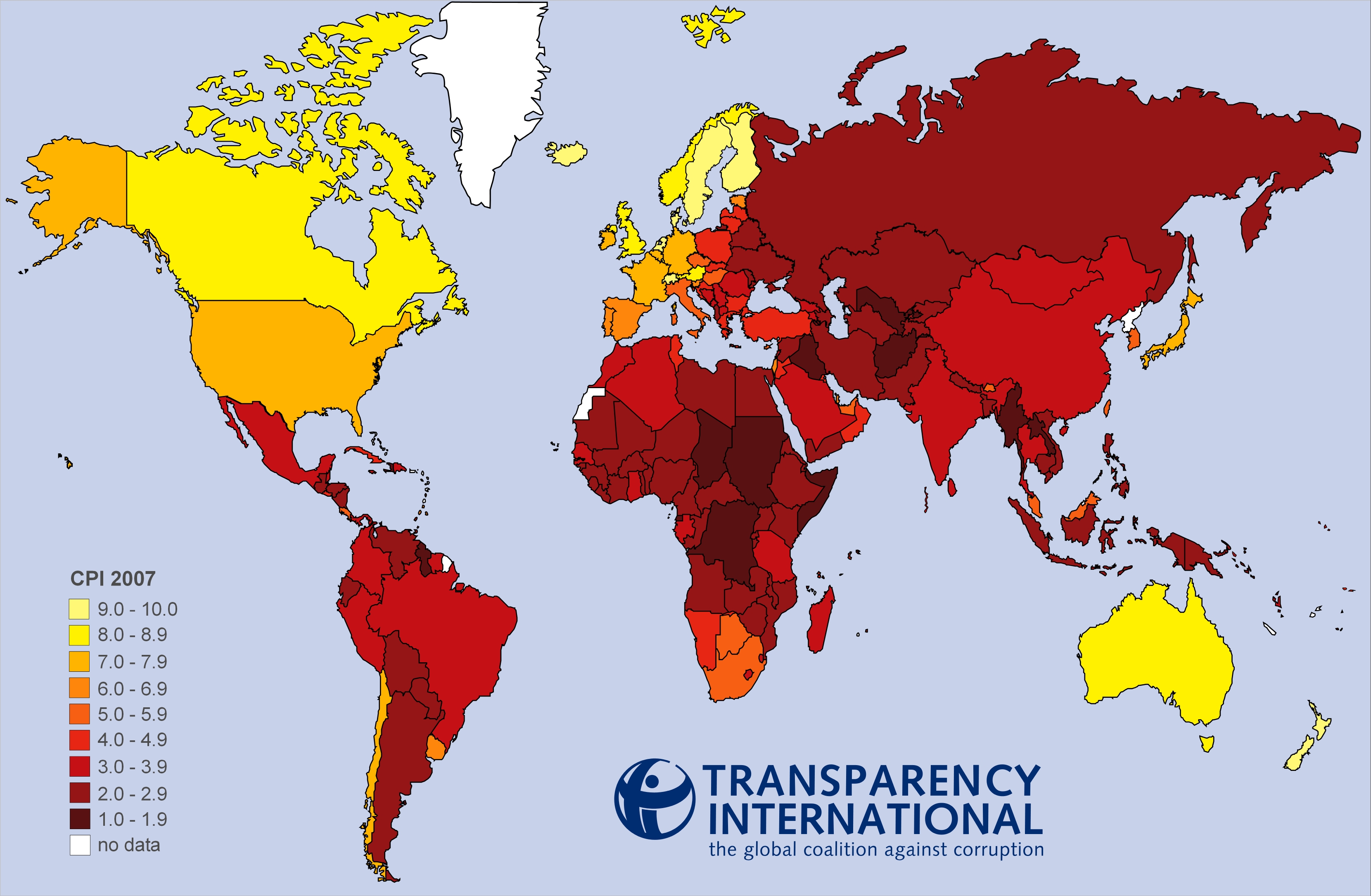
Since corruption was part of our readings this week I thought you might be interested in the "corruption perceptions index." In checking out the map above you can guess that the darkest shade of read represents lots of corruption.
TRANSPARENCY INTERNATIONAL is the organization that puts together the corruption index.
Subscribe to:
Posts (Atom)